Peace Lily
Spathiphyllum wallisii is a compact evergreen perennial forming dense clumps of arching, glossy lanceolate leaves directly from an underground rhizome. The prominent white 'flower' is a modified leaf called a spathe, which wraps around a central fleshy spike containing hundreds of tiny true flowers. It typically reaches a mature height of 30 to 45 cm indoors. Under moderate indirect light, it produces spathes intermittently throughout the spring and summer.
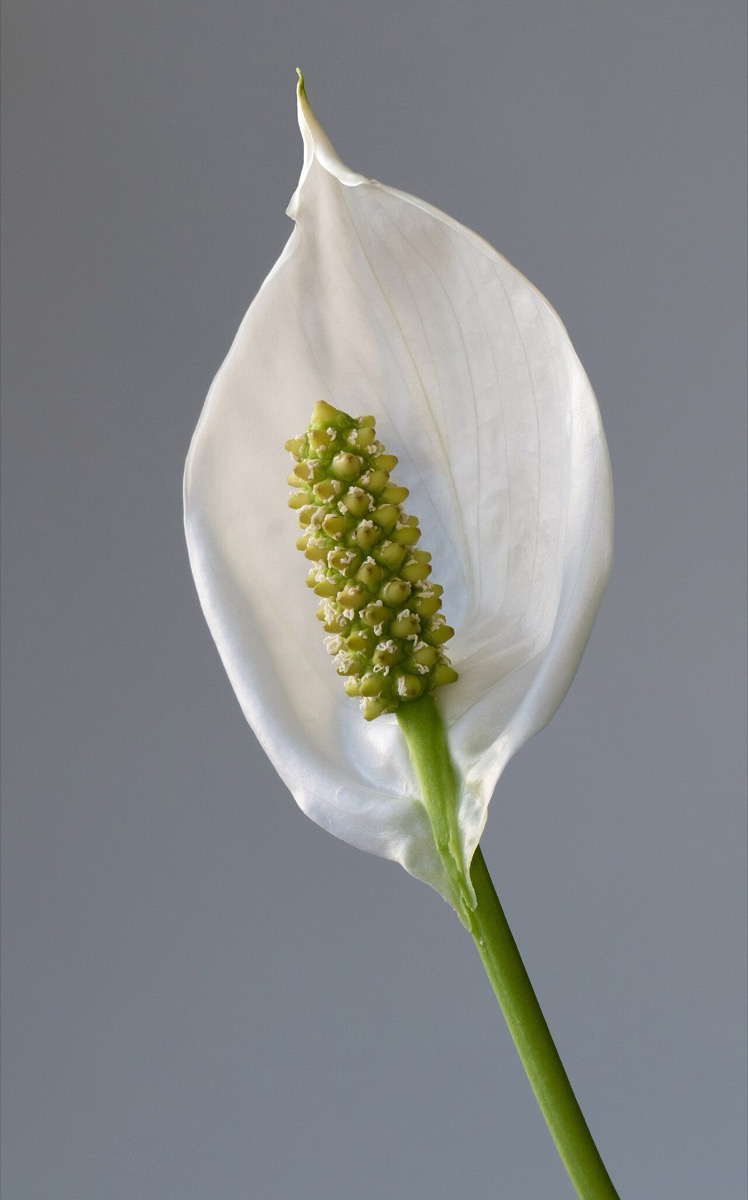
Also called Wallis' Peace Lily, White Sails, Spathe Flower.
Water thoroughly until water drains from the bottom when the top 2 to 3 cm of soil becomes dry to the touch, typically every 5 to 7 days in summer and every 10 to 14 days in winter. Never allow the pot to sit in standing water.
Medium to bright indirect light between 1,000 and 2,500 lux. It tolerates deep shade (down to 500 lux) but will stop producing spathes; direct sunlight burns the thin foliage.
A porous, peat- or coco-coir-based potting mix amended with 20% perlite and 10% fine orchid bark to maintain moisture while allowing rapid drainage (pH 5.8 to 6.5).
18°C to 26°C. Growth stalls below 15°C, and exposure to temperatures under 10°C causes leaf blackening and tissue collapse.
50% to 70% relative humidity. Foliage develops crispy brown tips if ambient humidity drops below 40%.
Apply a balanced liquid houseplant fertilizer diluted to half strength once every 6 weeks from March to September. Do not fertilize in winter.
All parts contain insoluble calcium oxalate crystals packaged in bundles called raphides. Chewing releases needle-like crystals that penetrate oral tissue, causing intense burning, swelling of the mouth and tongue, profuse drooling, and vomiting. Unlike true lilies (Lilium and Hemerocallis spp.), it does not cause acute kidney failure in cats.
How to tell them apart: Anthurium has thick, waxy, heart-shaped spathes (often red or pink) with distinct cordate leaf bases, whereas Spathiphyllum wallisii has thin, paper-like white spathes and slender lance-shaped leaves.
How to tell them apart: Spathiphyllum wallisii is a naturally dwarf species maxing out at 30 to 45 cm tall with 15 to 20 cm leaves, whereas 'Sensation' is a massive hybrid reaching over 1.5 metres in height with ribbed leaves up to 50 cm long.
How to tell them apart: Aglaonema features thick stems with boldly patterned, variegated leaves and rarely flowers indoors, while Spathiphyllum wallisii forms stemless rosettes of solid green leaves and readily produces white spathes.
- The white spathe contains chlorophyll and gradually turns green over several weeks as it ages, shifting its function from attracting pollinators to photosynthesis.
- The plant is highly sensitive to fluoride and chlorine additives in municipal tap water, which accumulate at leaf margins and cause dry brown tips regardless of watering routine.
- Commercial nurseries routinely spray juvenile plants with gibberellic acid (GA3) to force mass flowering ahead of seasonal retail sales.
Not sure this is what you have?
Upload a photo and find out — with the lookalikes it could also be.
Identify my plant