String of Pearls
Curio rowleyanus is a prostrate perennial succulent vine with thin, thread-like stems that can trail up to 1 m in length. Its modified leaves are entirely spherical, pea-sized globes designed to store water while minimizing surface area against rapid evaporation. In habitat, it creeps along rocky ground, rooting wherever stem nodes touch soil. During late autumn or winter, mature plants can produce small, brush-like white flowers with cinnamon-scented stamens.
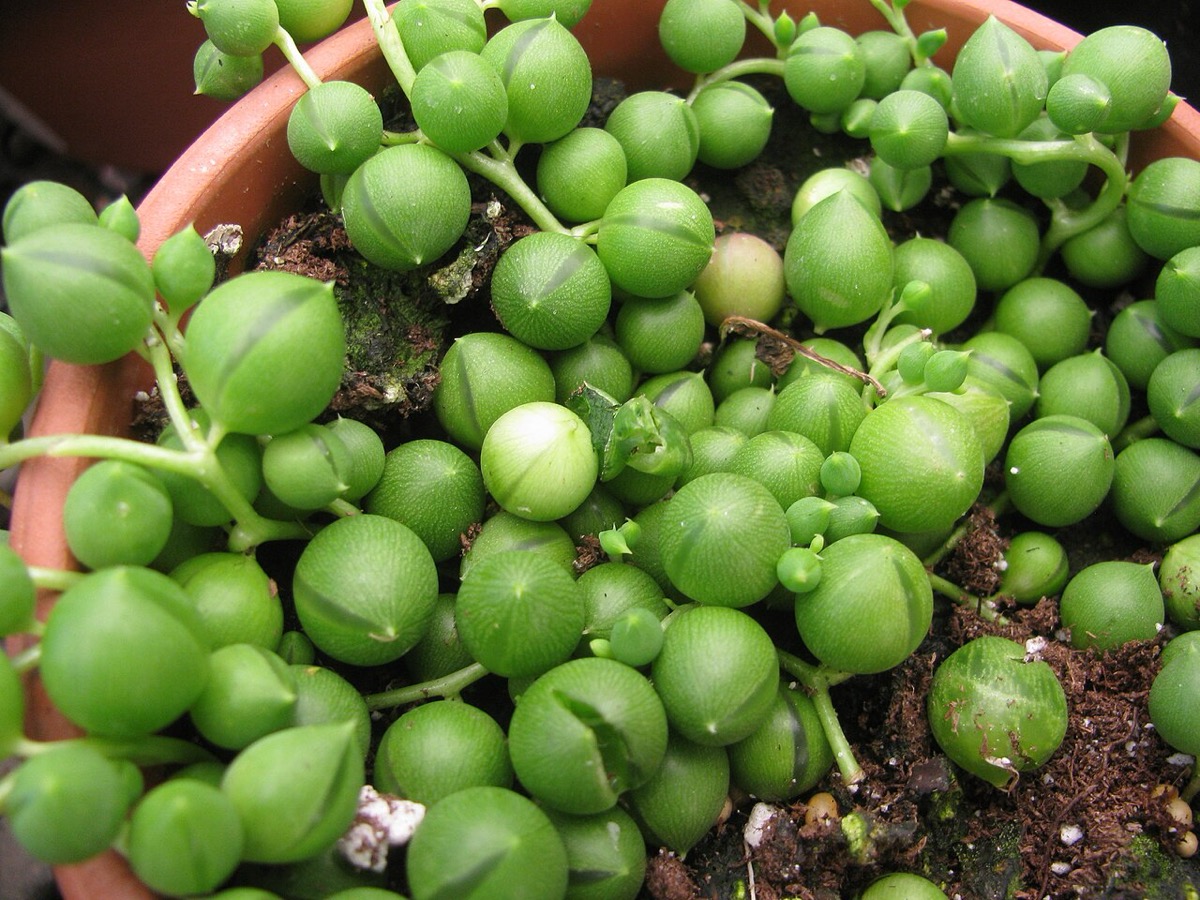
Also called Rosary Vine, String of Beads, Bead Plant, Curio rowleyanus.
How to care for it
Soak thoroughly every 10 to 14 days in spring and summer, allowing the potting mix to dry out almost completely between waterings. Reduce watering to every 3 to 4 weeks during winter dormancy. Wrinkling or slight flattening of the epidermal windows indicates the plant is dehydrated and ready for water.
Provide 6 to 8 hours of bright indirect light daily, including 2 to 3 hours of gentle morning direct sunlight. Ensure overhead light reaches the crown of the pot; if light only hits the trailing strands, the top stems thin out and die.
An inorganic, gritty succulent mix consisting of 60% pumice, perlite, or coarse sand combined with 40% peat-free potting compost. Use a shallow, porous terracotta container with wide drainage holes.
Maintain temperatures between 18°C and 24°C (64°F to 75°F) during the growing season. A cooler winter period between 10°C and 13°C (50°F to 55°F) encourages bud formation; do not expose to temperatures below 7°C (45°F).
Requires dry ambient air between 30% and 50% relative humidity. Never mist the foliage, as standing water between packed pearls promotes fungal infection and stem rot.
Apply a low-nitrogen, succulent-formulated liquid fertilizer diluted to quarter-strength (approximately 0.5 ml per litre) once monthly from April to August. Do not fertilize in autumn or winter.
Safety
Contains pyrrolizidine alkaloids throughout the plant tissue. Ingestion by cats or dogs triggers vomiting, diarrhea, drooling, depression, and progressive liver toxicity. Contact with the sap from ruptured pearls can cause acute contact dermatitis in humans.
Often mistaken for
How to tell them apart: Leaves are elongated, pointed teardrops or football shapes with distinct longitudinal stripes, unlike the spherical pearls of rowleyanus.
How to tell them apart: Leaves are distinctly crescent- or banana-shaped and curve upward from the stem, lacking the round, bead-like form.
Worth knowing
- Each spherical leaf possesses a narrow, translucent longitudinal band called an epidermal window that channels sunlight deep into the photosynthetic interior of the bead.
- In its native desert habitat, the plant grows primarily as a creeping ground cover shielded under rocks and shrubs, not as an aerial trailing plant.
- Its small, compound white blossoms produce prolonged dark purple stamens and yellow pollen, emitting a scent identical to cinnamon and cloves.
Not sure this is what you have?
Upload a photo to find out, along with the lookalikes it could also be.
Identify my plant