Satin pothos
Scindapsus pictus is a slow-to-moderate growing evergreen vine cultivated for its velvety, heart-shaped matte green leaves splashed with reflective silver variegation. When grown without a support to climb, it maintains its smaller juvenile foliage and trails downward. Leaves will visibly curl inward when the root zone becomes excessively dry, functioning as a clear visual cue for thirst. Despite its common name, it belongs to the distinct genus Scindapsus rather than Epipremnum.
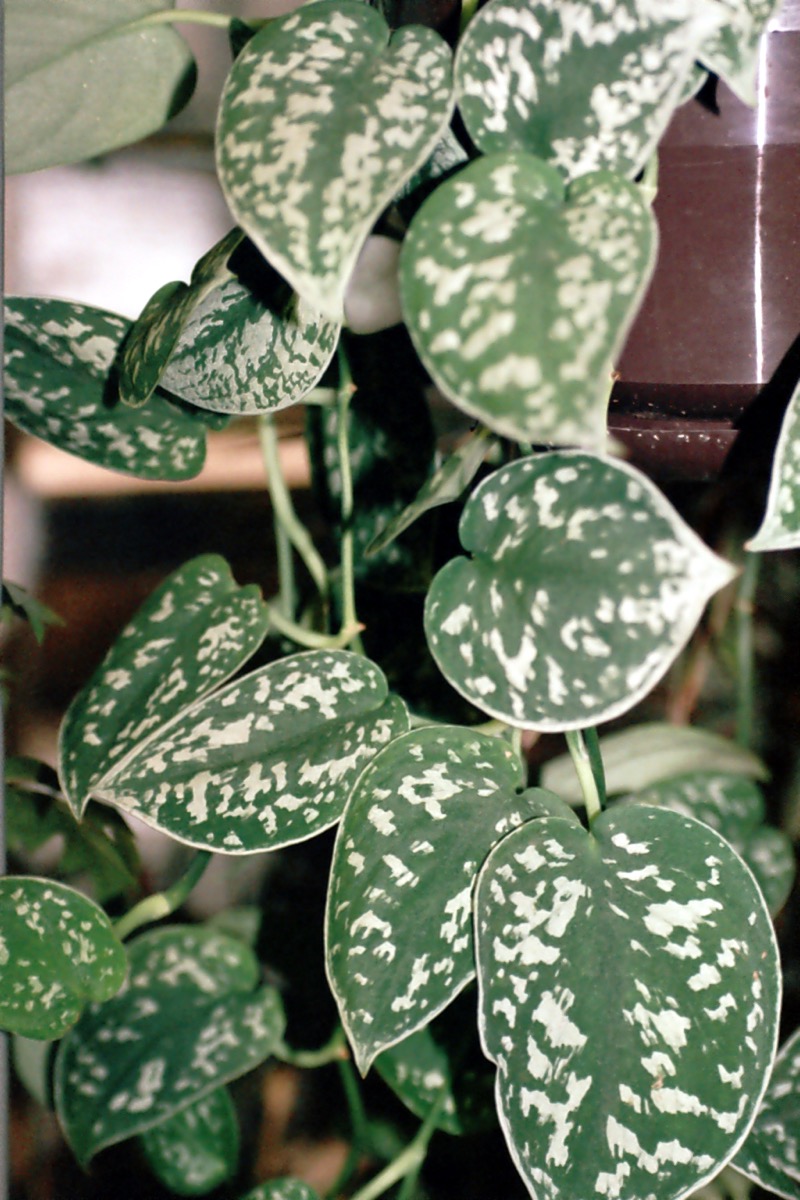
Also called Silver pothos, Silver vine, Spotted arum.
How to care for it
Water thoroughly until runoff drains freely once the top 5 to 7 cm (2 to 3 inches) of potting medium has completely dried out, typically every 7 to 10 days in spring and summer, reducing to every 14 to 18 days in winter. Pour out any standing water accumulated in the drainage saucer within 30 minutes to prevent root rot.
Provide bright, indirect sunlight around 2,000 to 3,500 lux, such as within 1 to 2 metres of an east- or partially shielded south-facing window. Avoid direct midday sun, which bleaches the foliage and scorches the silver patches; low light causes slow growth and reversion to solid green.
Use a coarse, free-draining aroid potting mix containing roughly 40% standard potting soil, 30% orchid bark (coarse pine bark), 20% perlite or pumice, and 10% horticultural charcoal or coco coir, targeting a pH between 6.0 and 6.5.
Maintain between 18°C and 27°C (65°F to 80°F). Sustained temperatures below 15°C (59°F) trigger leaf drop, and sudden cold drafts below 10°C (50°F) cause rapid cellular collapse and blackening of the leaves.
Thrives in ambient relative humidity between 50% and 70%. Tolerates typical household levels of 40% to 50%, but leaf tips turn brown and crispy if humidity remains consistently below 40%.
Apply a balanced liquid houseplant fertilizer (such as an N-P-K 10-10-10 or 20-20-20) diluted to half-strength once every four weeks during active spring and summer growth. Withhold all fertilizer completely throughout autumn and winter.
Safety
All parts of the plant contain insoluble calcium oxalate crystals and proteolytic enzymes. Chewing or ingesting releases microscopic needle-like raphides that pierce soft tissue, causing immediate oral pain, swelling of the lips, tongue, and throat, excessive drooling, vomiting, and difficulty swallowing. Direct skin exposure to broken sap can cause contact dermatitis.
Often mistaken for
How to tell them apart: Epipremnum aureum features glossy, waxy, smooth foliage with yellow, cream, or white streaks, whereas Scindapsus pictus leaves have a distinct matte, velvety texture, prominent silver-grey spots, and asymmetric leaf bases with one side visibly broader than the other.
How to tell them apart: Philodendron hederaceum features symmetrical heart-shaped leaves that emerge from distinct cataphylls (sheaths that dry and drop off), lacking both the velvety silver patches and the asymmetric, curved apex typical of Scindapsus.
Worth knowing
- The distinctive silvery sheen is an optical effect created by microscopic air pockets beneath the leaf epidermis that reflect incident light, rather than actual silver pigments.
- Unlike common trailing pothos (Epipremnum), Scindapsus pictus strictly produces only a single ovule per ovary, which is one of the definitive botanical traits distinguishing the genus Scindapsus within the arum family.
- When mounted on a moist moss pole or rough wood plank, it exhibits shingling behavior in which the leaf blades flatten flush against the support, climbing upward and growing up to 30 cm long as the plant matures.
Not sure this is what you have?
Upload a photo to find out, along with the lookalikes it could also be.
Identify my plant