Thanksgiving Cactus
An epiphytic cactus that grows on trees and shaded rocky outcrops rather than arid deserts. Its arching stems consist of flat, green segments with pointed, claw-like teeth along the margins. Bilaterally symmetrical flowers with protruding yellow-anthered stamens emerge from the segment tips in late autumn. Lacking sharp spines, it requires consistent moisture, high humidity, and protection from hot sun.
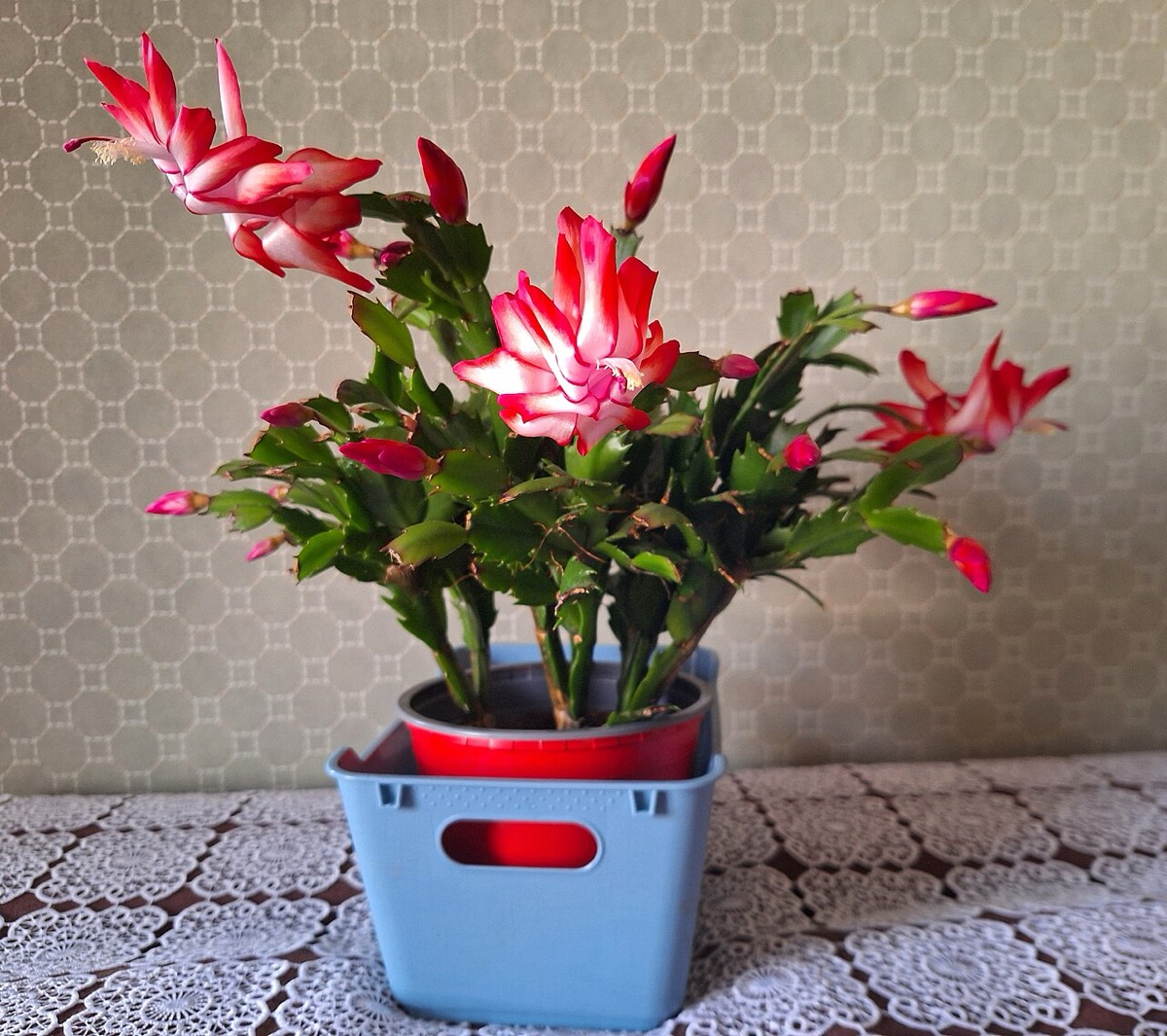
Also called False Christmas Cactus, Claw Cactus, Crab Cactus, Holiday Cactus.
How to care for it
Water thoroughly until liquid drains freely from the base once the top 2.5 cm (1 inch) of substrate has dried completely, typically every 7 to 10 days during active growth. Reduce watering to once every 14 to 21 days for six weeks immediately following the winter bloom period.
Bright, filtered indirect light of 1,500 to 3,000 lux. Avoid direct sun during mid-spring through autumn, which bleaches stem segments or scorches them reddish-purple.
Coarse, acidic, well-aerated epiphytic potting mix comprising 2 parts standard potting soil, 1 part perlite or pumice, and 1 part fine orchid bark with a pH between 5.5 and 6.2.
Keep between 18°C and 24°C (65°F to 75°F) through spring and summer. To initiate flower buds in autumn, provide 6 to 8 weeks of night temperatures between 12°C and 16°C (54°F to 60°F); do not expose to drafts below 10°C (50°F).
50% to 70% relative humidity. If ambient household air falls below 40%, bud drop and shriveled stems frequently occur.
Apply a balanced liquid houseplant fertilizer (such as 10-10-10 or 20-20-20) diluted to half strength every 4 weeks from April through August. Stop all fertilizing by mid-September when setting buds.
Safety
Non-toxic to dogs, cats, and humans. Ingesting large quantities of fibrous stem segments may cause mechanical stomach irritation, drooling, or mild vomiting in small animals.
Often mistaken for
How to tell them apart: Stem segments of S. × buckleyi have rounded, scalloped margins lacking sharp teeth, and flowers hang straight down with radially symmetrical petals.
How to tell them apart: Segments feature rounded margins with subtle brownish bristles at the joints, and blooms appear in spring as star-shaped, radially symmetrical flowers.
Worth knowing
- Flower bud development requires 12 to 14 hours of uninterrupted darkness each night for 6 continuous weeks in early autumn.
- The flowers are zygomorphic (bilaterally symmetrical) and hold an upward horizontal angle specifically evolved for pollination by hummingbirds.
- Rotating the pot or exposing it to hot or cold drafts once flower buds form causes the plant to abort and drop its unopened buds.
- In its native canopy habitat, it grows as an epiphyte anchored in moss and organic debris accumulated in tree crotches.
Not sure this is what you have?
Upload a photo to find out, along with the lookalikes it could also be.
Identify my plant