Christmas Cactus
This is a thornless, epiphytic cactus made of flattened, arching stem segments rather than true leaves. Its magenta, pink, or red tubular flowers hang pendulously from the stem tips in mid to late winter. In the wild, its parent species grow attached to trees or rock crevices under high canopy shade. It is exceptionally long-lived and frequently passed down as a family heirloom for decades.
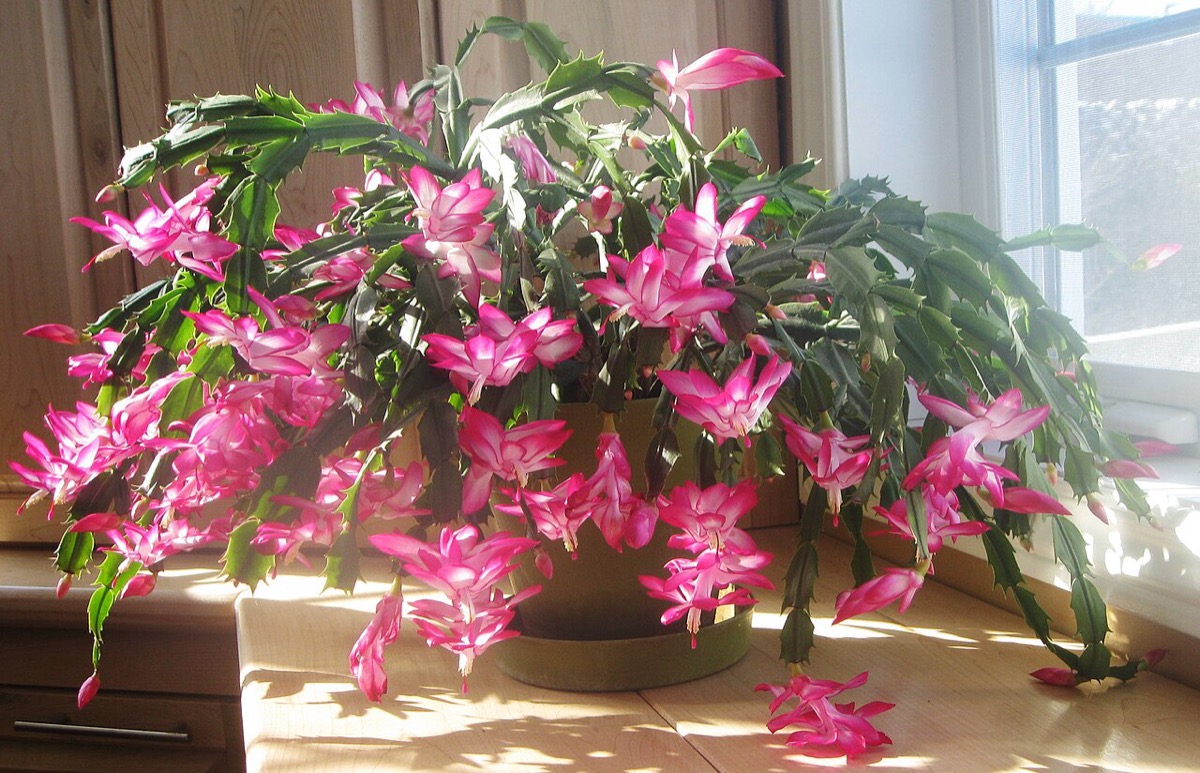
Also called True Christmas Cactus, Buckley Cactus.
How to care for it
Soak thoroughly every 7 to 10 days in active growth, letting excess drain away completely; water only when the top 3 to 4 cm of potting mix is dry. Reduce watering to roughly every 2 to 3 weeks in late autumn to trigger bud formation.
Provide bright, filtered indirect light (such as near an east-facing window); avoid direct midday sun, which turns the stems reddish-purple and causes sun scorch.
Use a porous, aerated, slightly acidic mix of 2 parts standard potting soil, 1 part perlite or pumice, and 1 part fine orchid bark.
Maintain between 18°C and 22°C (65°F to 72°F) during the growing season. To set flower buds in autumn, provide night temperatures between 12°C and 15°C (53°F to 59°F).
Requires moderate to high humidity between 50% and 65%; unheated winter home air below 40% will cause flower buds to drop before opening.
Apply a balanced liquid houseplant fertiliser diluted to half strength (e.g. NPK 10-10-10 at 1 ml per litre of water) every 4 weeks from April through September. Cease completely in October and during bloom.
Safety
Non-toxic to cats, dogs, and humans according to the ASPCA. Ingesting large amounts of plant matter may cause mild, transient mechanical stomach upset in small pets.
Often mistaken for
How to tell them apart: Schlumbergera truncata features sharp, pointed claw-like teeth on segment margins and asymmetric, horizontally held flowers, whereas S. × buckleyi has rounded, scalloped margins and symmetrical, downward-drooping flowers.
How to tell them apart: Rhipsalidopsis gaertneri has rounded margins with small brownish bristles at the segment joins and blooms in spring with star-shaped, pointed petals rather than double-layered tubular flowers.
Worth knowing
- Most commercially sold 'Christmas cacti' are actually Schlumbergera truncata (Thanksgiving cactus); true S. × buckleyi is rare in garden centres and mostly circulated via cuttings.
- It is an obligate short-day plant, requiring roughly 12 to 14 hours of uninterrupted total darkness each night for 6 straight weeks in autumn to set flower buds.
- Drafts, sudden temperature drops, or rotating the pot once flower buds have formed will cause the plant to immediately abort and drop its unopened buds.
Not sure this is what you have?
Upload a photo to find out, along with the lookalikes it could also be.
Identify my plant