Elephant Bush
A woody-stemmed succulent shrub that grows up to 4 metres tall in habitat, but remains much smaller in cultivation. It features deep reddish-brown, highly flexible stems lined with small, glossy, round emerald leaves. Unlike the true jade plant, its branching structure is nimble and tapers gracefully, making it a popular subject for indoor bonsai. Clusters of tiny star-shaped pink flowers appear after dry seasons in the wild, though rarely indoors.
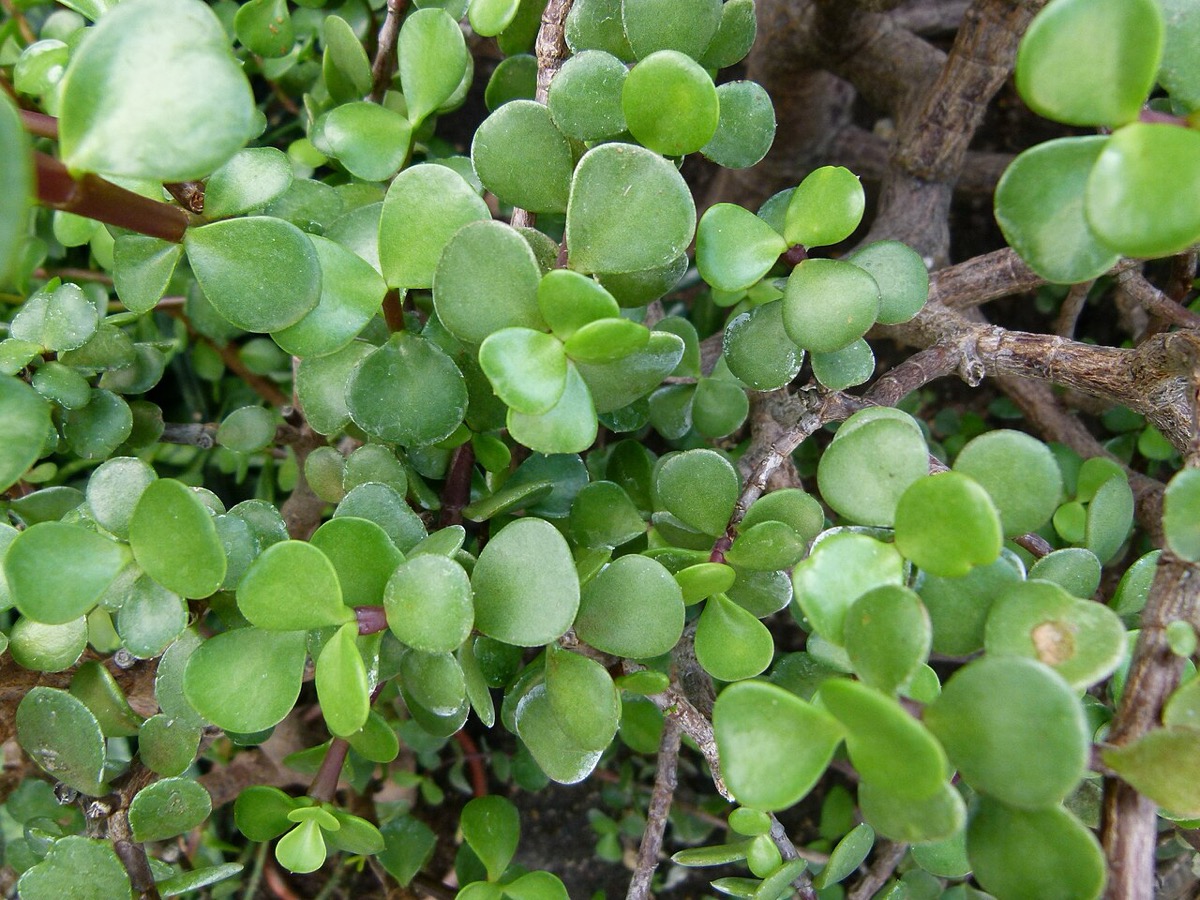
Also called Spekboom, Porkbush, Dwarf Jade Plant, Elephant's Food.
How to care for it
Soak the pot thoroughly until water drains from the base, then wait until the entire substrate is dry all the way to the bottom. In warm months this is typically every 10 to 14 days, reducing to once every 3 to 4 weeks in winter. Wrinkled leaves indicate under-watering; soft, dropping leaves signal root saturation.
Requires at least 6 hours of direct sunlight daily. Place directly on an unobstructed south- or west-facing windowsill; insufficient light causes weak, leggy stems and leaf shedding.
Extremely gritty, free-draining substrate composed of 60% inorganic grit (such as pumice, perlite, or lava rock) and 40% organic potting soil. The pot must have active drainage holes.
Maintains best growth between 18°C and 28°C (64°F–82°F). It can withstand extreme summer heat up to 40°C, but will suffer leaf drop and tissue damage below 5°C (41°F); keep strictly above freezing.
Thrives in dry air with 30% to 50% relative humidity. Avoid humid bathrooms or misting, which encourages fungal stem rot.
Apply a balanced liquid succulent fertilizer diluted to half strength once every 4 weeks from April through September. Do not fertilize late autumn through winter.
Safety
Non-toxic to humans, dogs, cats, and livestock.
Often mistaken for
How to tell them apart: Portulacaria afra has reddish-brown flexible stems with smaller, thinner leaves (1 to 2 cm), whereas Crassula ovata has thick, rigid grey stems, larger leaves (3 to 5 cm), and is toxic to pets.
Worth knowing
- It can switch its photosynthetic pathway from C3 during moist conditions to Crassulacean Acid Metabolism (CAM) during drought to minimise water loss through transpiration.
- Because of its dense canopy and rapid growth, it sequesters atmospheric carbon at rates comparable to moist subtropical forests despite growing in arid conditions.
- In South Africa, the succulent leaves are traditionally chewed by people to quench thirst, soothe sore throats, and added fresh to salads for a crisp, tart, citrus-like flavor.
Not sure this is what you have?
Upload a photo to find out, along with the lookalikes it could also be.
Identify my plant