Chinese Money Plant
Pilea peperomioides is an upright, semi-succulent perennial grown for its circular, bright-green peltate leaves that balance on slender petioles. Over time, the lower leaves naturally shed to reveal a thick, woody central stem that can reach 30 to 45 cm in height. It naturally propagates by sending subterranean runners that erupt around the base as miniature clones. While small clusters of pale green-to-pink blossoms appear in spring following a winter chill, it is predominantly cultivated for its striking geometric foliage.
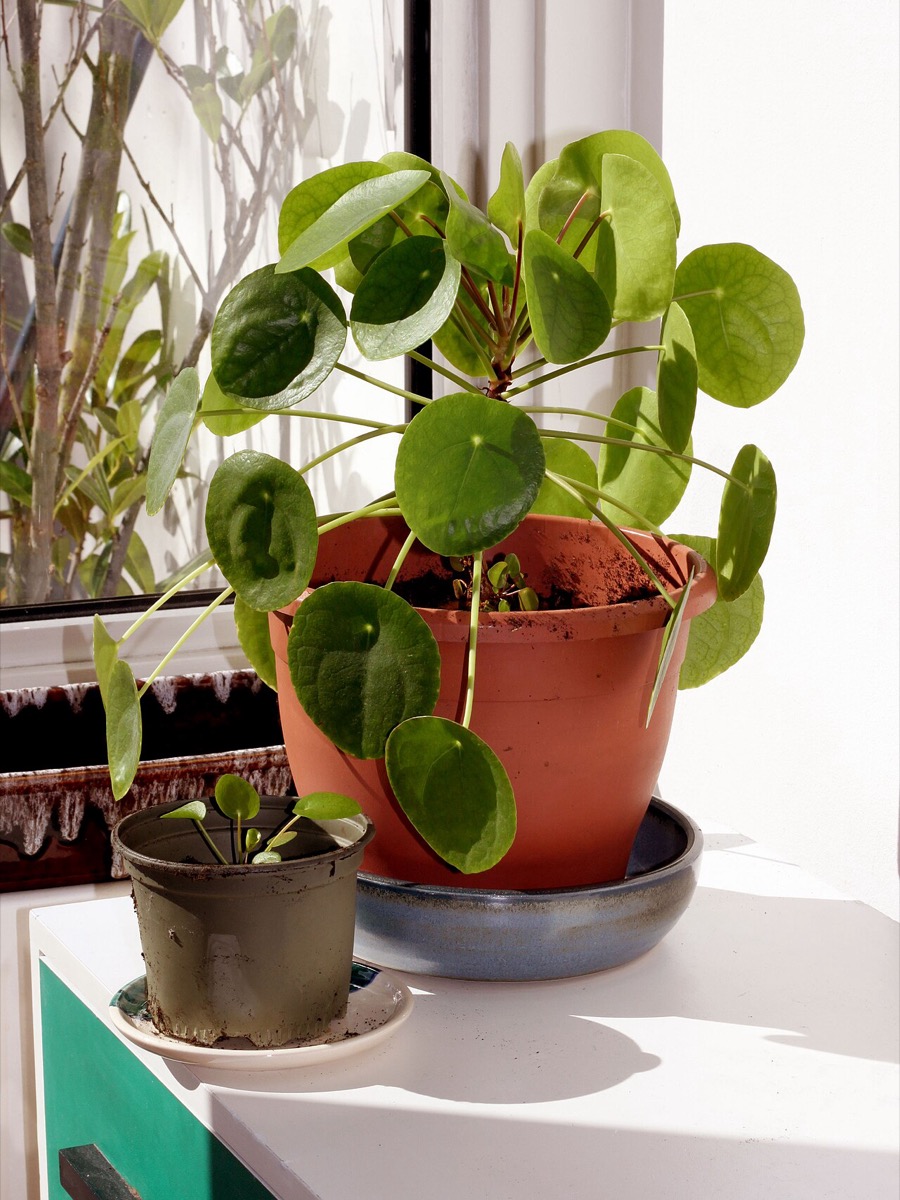
Also called Pancake Plant, UFO Plant, Pass-it-on Plant, Missionary Plant.
How to care for it
Drench the soil thoroughly every 7 to 10 days during active spring and summer growth, extending the interval to every 12 to 14 days in winter; water only when the top 3 cm (1.2 in) of soil has dried completely. Ensure drainage holes are never blocked, as stagnant water at the roots rapidly triggers root rot and leaf loss.
Provide bright, indirect sunlight measuring between 2,000 and 4,000 lux. Direct midday sun bleaches and scorches the circular foliage, whereas insufficient light leads to leggy petioles and dome-shaped, curling leaves. Rotate the pot 90 degrees weekly to prevent the single primary stem from bending toward light sources.
Use a loose, fast-draining potting medium with a pH between 6.0 and 7.0. A blend composed of 2 parts high-quality peat or coco-based potting soil, 1 part perlite, and 1 part pumice or coarse horticultural sand provides the aeration necessary to safeguard against rot.
Maintain temperatures between 16°C and 24°C (61°F to 75°F). Never expose the plant to temperatures below 10°C (50°F) or place it in drafty corridors, though a temporary winter dip to 12°C to 15°C (54°F to 59°F) can trigger spring inflorescence.
Standard indoor relative humidity between 40% and 60% is sufficient. Below 30% relative humidity, leaf edges may turn brittle and dry; avoid placing the pot directly adjacent to active forced-air heaters or air-conditioning vents.
Feed with a balanced 10-10-10 liquid houseplant fertilizer diluted to half-strength once every 3 to 4 weeks from April through September. Withhold all fertilizer during autumn and winter when metabolic activity slows.
Safety
Neither the foliage nor the stems contain toxic compounds for cats, dogs, or humans. Ingestion of raw plant material in large volumes may cause mechanical irritation or minor vomiting due to fibrous cellulose, but no toxic reactions occur.
Often mistaken for
How to tell them apart: Peperomia polybotrya has thicker, waxy leaves that taper into a distinct pointed teardrop tip, unlike the uniform round disc leaves of Pilea peperomioides.
How to tell them apart: Hydrocotyle vulgaris spreads via horizontal creeping stems with scalloped or shallowly lobed leaf margins, while Pilea peperomioides forms an erect, woody central trunk with entire leaf margins.
Worth knowing
- The tiny white granules often found on the undersides of the leaves are benign mineral and salt deposits excreted through specialized leaf pores called hydathodes.
- The species was distributed worldwide primarily through informal amateur gardener networks after Norwegian missionary Agnar Espegren brought cuttings from Kunming, China to Europe in 1946.
- Pilea peperomioides exhibits strong phototropism; the entire crown will visibly tilt toward the strongest light direction within a span of 48 hours if not rotated regularly.
Not sure this is what you have?
Upload a photo to find out, along with the lookalikes it could also be.
Identify my plant