Swiss cheese vine
A vigorous evergreen hemiepiphytic vine that climbs trees or scrambles across the forest floor. Its oval foliage naturally develops enclosed perforations along the midrib, which remain closed at the leaf margin. Allowed to trail, leaves stay 8 to 15 cm long, but climbing plants with moss support can produce leaves reaching over 35 cm. It produces long, leafless searcher stolons when light levels fall or climbing support is absent.
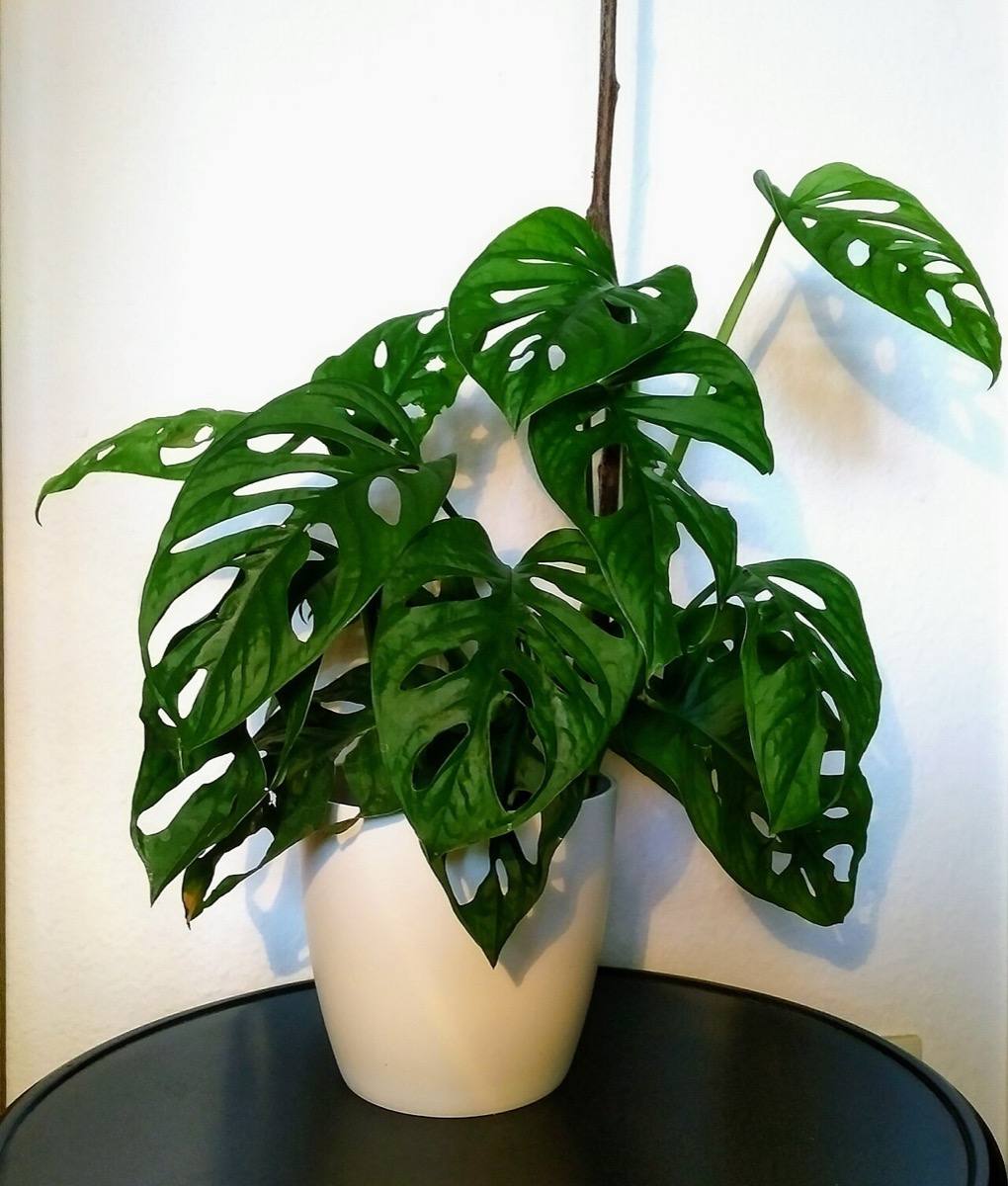
Also called Adanson's monstera, Monkey mask plant, Five holes plant.
How to care for it
Soak the substrate thoroughly when the top 3 cm (1.2 inches) dries out, draining all excess water from the cachepot; this typically means watering every 6 to 9 days in summer and every 12 to 16 days in winter.
Thrives in 2,500 to 4,000 lux of bright, indirect sunlight within 1 to 2 metres of an east-facing or filtered west-facing window; harsh direct midday sun burns brown patches into the thin leaf tissue within hours.
An open, highly aerated aroid potting mix made of roughly 40% medium pine bark chips, 30% coconut coir, 20% coarse perlite, and 10% worm castings, with a target pH of 5.5 to 6.5.
Maintain temperatures between 18°C and 27°C (64°F and 81°F); growth stalls below 16°C (61°F), and cellular tissue damage occurs below 10°C (50°F).
Requires 60% relative humidity or higher for vigorous development; ambient levels below 45% result in crispy brown leaf tips and cause new unfurling leaves to stick and rip.
Feed every 2 to 3 weeks during active growth from March to September using an NPK 20-20-20 or 3-1-2 water-soluble fertiliser diluted to half the manufacturer recommended rate; withhold fertiliser entirely in winter.
Safety
All plant tissues contain insoluble calcium oxalate crystals packaged in bundles called raphides. Chewing releases needle-like crystals that penetrate oral mucous membranes, causing immediate burning, severe swelling of the lips and pharynx, hypersalivation, dysphagia, and vomiting.
Often mistaken for
How to tell them apart: Monstera obliqua foliage is paper-thin with holes accounting for up to 90% of the leaf surface, and it is exceptionally rare in cultivation, whereas Monstera adansonii has thicker, leatherier leaves with roughly 50% hole coverage.
How to tell them apart: Monstera esqueleto has significantly larger mature leaves (up to 60 cm), a paler green color, and double rows of perforations flanking the central vein.
Worth knowing
- The leaf holes, called fenestrations, reduce drag from high rainforest winds and heavy rain while allowing light to filter through to the plant's lower leaves.
- Produces leafless stolons (runners) that navigate across the forest floor in search of dark vertical silhouettes (trees), a survival trait known as negative phototropism or skototropism.
- Named in honour of French naturalist Michel Adanson, who categorized tropical aroid species in the 18th century.
Not sure this is what you have?
Upload a photo to find out, along with the lookalikes it could also be.
Identify my plant