Prayer plant
A low-growing rhizomatous perennial with broad, patterned oval leaves that sprawl outward rather than grow tall. Each evening, the leaves fold upward into an erect posture through fluid shifts in specialized joints, then lower flat again by morning. It rarely exceeds 30 cm in height indoors, instead spreading horizontally via branching, prostrate stems. In bright conditions, it periodically produces small, short-lived pale purple flowers on thin racemes.
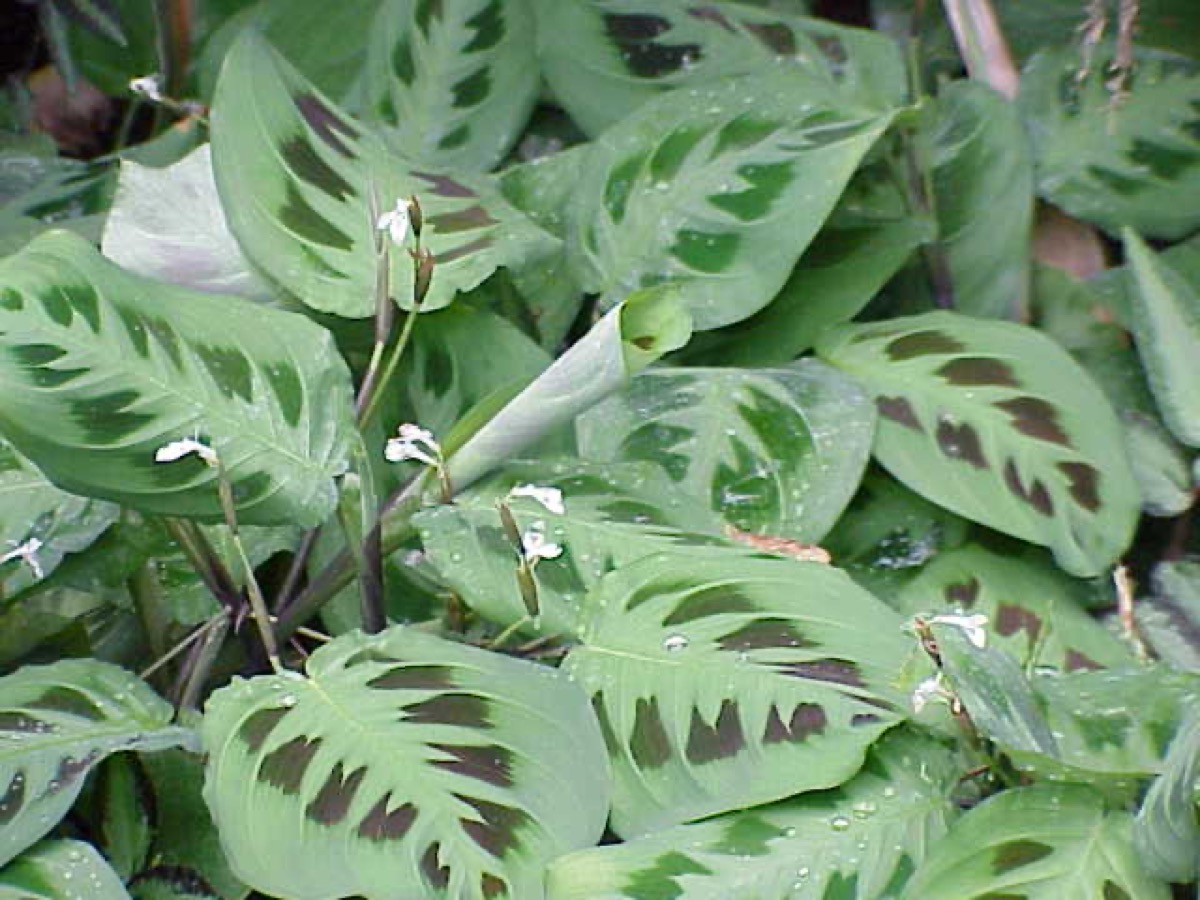
Also called Herringbone plant, Cathedral windows, Rabbit tracks.
How to care for it
Water thoroughly every 5 to 7 days during spring and summer once the top 2 cm (0.8 inches) of soil feels dry, reducing to every 10 to 14 days in winter. Use distilled water, rainwater, or reverse osmosis water; tap water minerals, fluoride, and chlorine quickly produce brown, scorched leaf margins.
Provide bright, indirect light between 1,000 and 2,500 lux. Keep the plant shielded from direct sun, which bleaches the foliage patterns and scorches the leaf tissue within hours.
A loose, airy, and moisture-retentive potting mix with a pH between 5.5 and 6.5, consisting of two parts peat moss or coco coir, one part perlite, and one part organic potting soil.
Maintain between 18°C and 27°C (64°F to 81°F). Exposure to temperatures below 15°C (59°F) triggers cold stress, blackening leaf edges and inciting root rot.
Requires steady relative humidity of at least 50%, with 60% or higher preferred. Dry air below 40% causes leaf curling and necrotic edges.
Feed every 2 to 3 weeks from April to September with a balanced liquid houseplant fertilizer diluted to half strength (0.5 to 1 ml per litre of water). Withhold fertilizer entirely throughout the winter dormancy.
Safety
Considered non-toxic to dogs, cats, and humans by the ASPCA and poison control centers, though consuming fibrous raw foliage can cause mild stomach upset in small animals.
Often mistaken for
How to tell them apart: Goeppertia grows in erect, vase-shaped basal rosettes directly from rootstocks, whereas Maranta leuconeura develops creeping, jointed stems with distinct nodes that trail and spread horizontally.
How to tell them apart: Goeppertia insignis has long, stiff, lance-shaped leaves with wavy margins and dark blotches, whereas Maranta leuconeura has wide, flexible, rounded oval leaves with herringbone-patterned lateral veins.
Worth knowing
- The daily movement of the leaves, known as nyctinasty, is driven by the pulvinus—a swollen organ at the base of the petiole that moves water between cell layers like a hydraulic hinge.
- Unlike most other prayer-plant relatives in the Marantaceae family which can only be divided at the roots, Maranta leuconeura readily roots from stem cuttings cut just below a swollen node.
- The specific epithet 'leuconeura' is derived from Greek words meaning 'white-veined', referring to the light-coloured lateral ribs characteristic of the botanical type.
Not sure this is what you have?
Upload a photo to find out, along with the lookalikes it could also be.
Identify my plant