Calathea Orbifolia
Goeppertia orbifolia is an evergreen perennial prized for its oversized, rounded leaves patterned with metallic silver and green bands. It grows as a clumping rhizomatous plant reaching 60 to 90 cm in height indoors. Like other members of the Marantaceae family, its foliage moves upward at night and lowers during the daytime. It requires consistently high humidity and mineral-free water to prevent leaf edge necrosis.
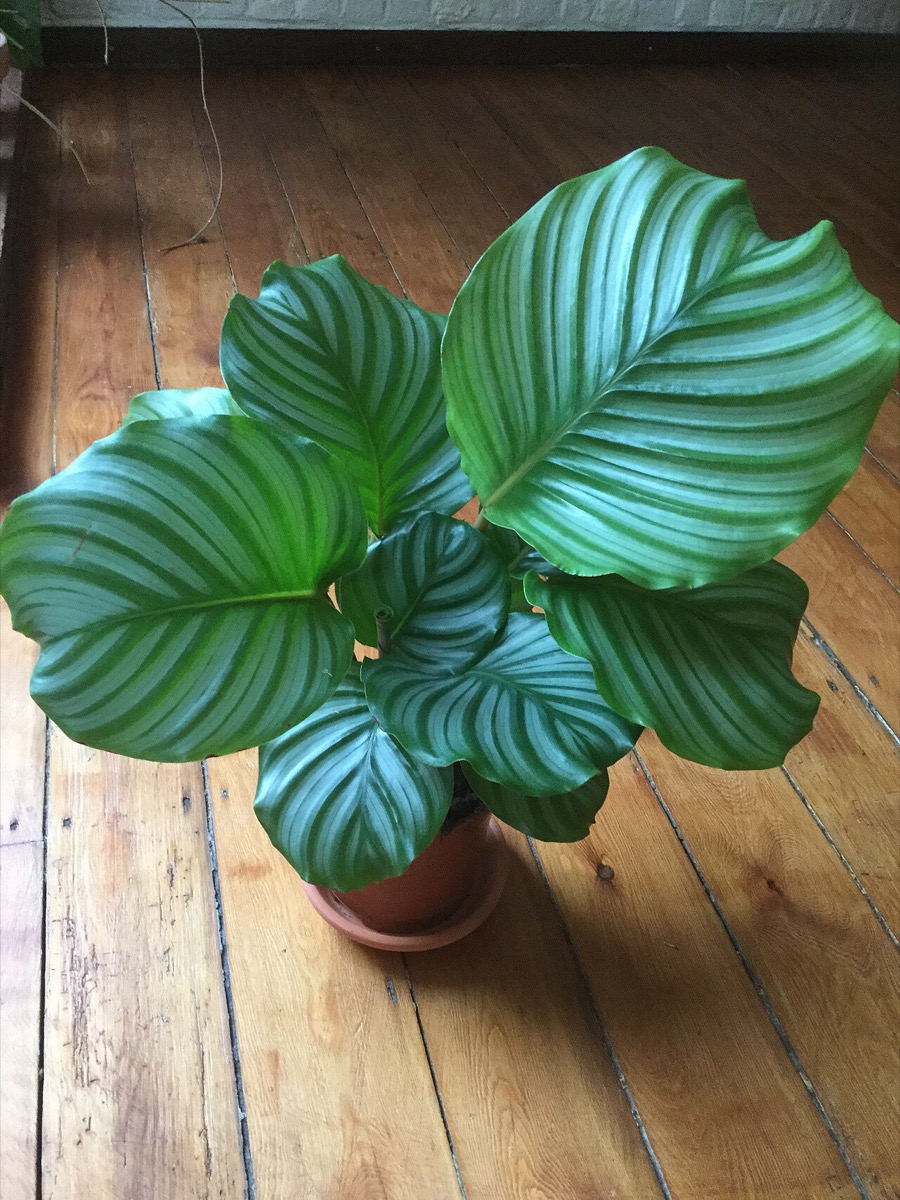
Also called Orbifolia Prayer Plant, Round-Leaved Calathea.
Water thoroughly every 5 to 7 days in spring and summer, extending to every 10 to 12 days in winter, when the top 2 to 3 cm of soil has dried. Always use distilled water, rainwater, or reverse osmosis water at 20°C to 24°C, as dissolved tap salts and fluoride cause irreversible edge browning.
Provide bright, filtered light between 1,000 and 2,500 lux, placed 1 to 2 metres away from an east- or north-facing window. Never expose to direct sunlight, which bleaches the silver striping and scorches the leaf tissue.
Use a loose, acidic to neutral potting mix (pH 6.0 to 6.5) composed of 2 parts coco coir or peat moss, 1 part perlite, and 1 part fine orchid bark for drainage.
Maintain between 18°C and 26°C (65°F to 79°F). Do not allow temperatures to drop below 15°C (59°F), and keep away from cold drafts or heating vents.
Keep relative humidity at 60% or higher at all times. Levels sustained below 50% result in curled leaf edges and brown, crispy margins.
Feed every 4 weeks from April to August using a balanced liquid foliage fertilizer diluted to quarter strength (roughly 0.5 ml per litre of water). Do not fertilize from October to February.
Goeppertia orbifolia is non-toxic to domestic animals (dogs and cats) and humans. Ingesting large quantities of fibrous raw plant matter may still cause mild mechanical stomach irritation or vomiting in small pets.
How to tell them apart: Goeppertia fasciata has thicker, darker green leaves with less silver variegation and deep purple undersides, whereas Goeppertia orbifolia has pale green undersides.
How to tell them apart: Goeppertia rotundifolia possesses narrower, more upright elliptic leaves with faint, thin line markings rather than wide metallic silver bands.
- Leaf movement (nyctinasty) is controlled by the pulvinus, a flexible hinge-like swelling at the junction between the leaf blade and the petiole that alters internal water pressure.
- The plant was historically classified under the genus Calathea before molecular DNA analysis moved it to Goeppertia in 2012.
- Individual leaf blades can reach over 35 cm in width on mature specimens grown under stable high-humidity conditions.
Not sure this is what you have?
Upload a photo and find out — with the lookalikes it could also be.
Identify my plant