Rubber plant
Ficus elastica is a broadleaf evergreen tree with thick, leathery leaves that have a smooth, glossy surface and a prominent central vein. Indoors, it grows as a sturdy upright tree reaching between 1 and 3 metres in height. New leaves emerge from a protective reddish or pinkish stipule sheath that drops off as the blade unfolds. Any puncture or cut to the stem or leaves instantly exudes a sticky, milky white latex sap.
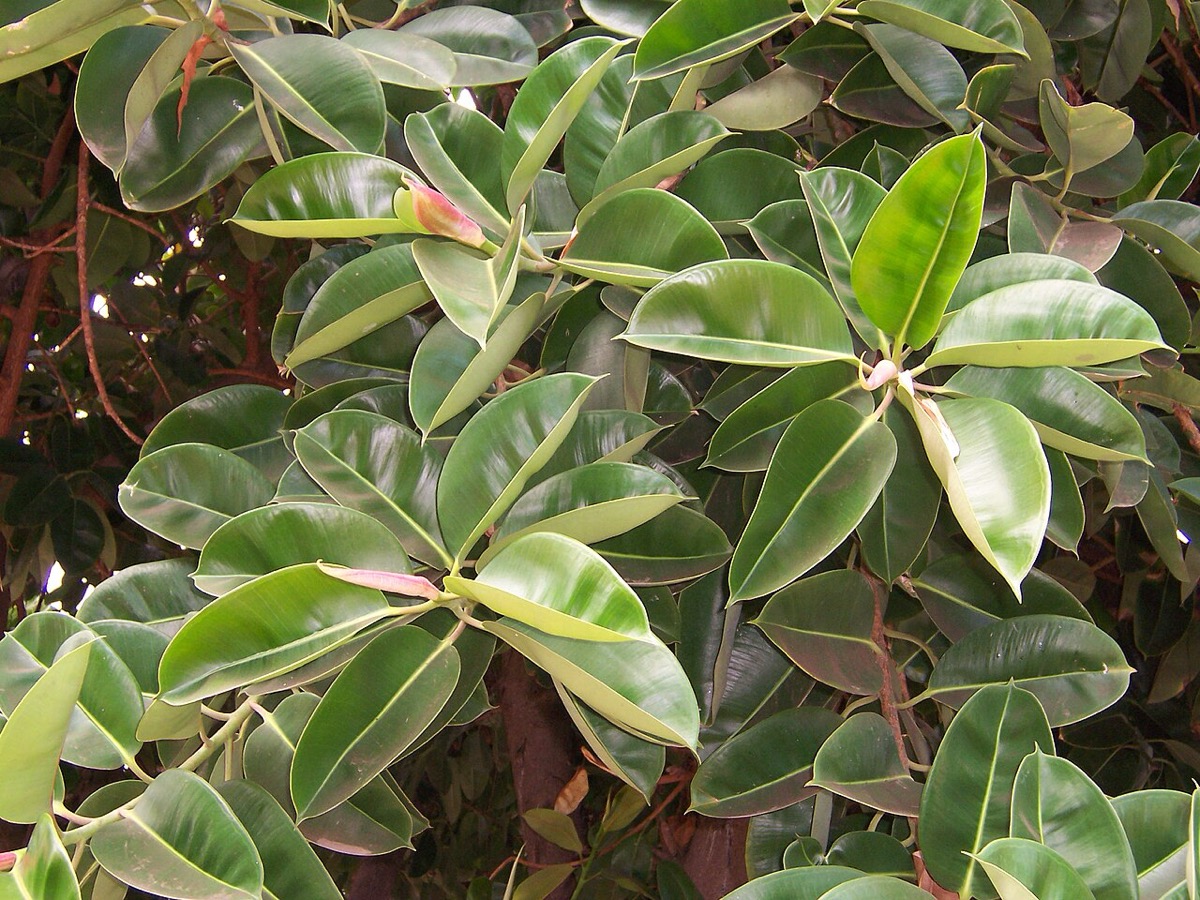
Also called Rubber fig, Rubber tree, Indian rubber bush, India rubber tree.
Water thoroughly with 0.5 to 1.5 litres of water until it flows freely from the drainage holes, then empty the tray. Allow the top 5 cm (2 inches) of soil to dry out completely between waterings, which typically translates to once every 7 to 10 days in summer and every 14 to 21 days in winter.
Requires 6 to 8 hours of bright, indirect light daily. It can handle up to 2 hours of gentle morning sun, but intense direct midday sun will scorch the leaves, while sustained low light causes lower leaf drop.
A loose, well-draining potting mix. Combine 2 parts peat or coco coir potting soil with 1 part perlite and 1 part pine bark fines.
Maintains best growth between 16°C and 27°C (61°F to 81°F). Avoid sudden temperature swings, cold drafts, and temperatures below 12°C (54°F).
Thrives at 40% to 60% relative humidity. Normal household humidity is sufficient, though dry winter heating requires occasional leaf wiping with a damp cloth to remove dust.
Apply a balanced liquid houseplant fertilizer (such as 10-10-10) diluted to half strength every 4 weeks from April through September. Do not fertilize during autumn and winter.
All parts contain milky sap rich in ficin (a proteolytic enzyme) and ficusin (a phototoxic psoralen). Ingestion causes oral pain, heavy drooling, vomiting, and diarrhea in dogs and cats. Skin contact causes contact dermatitis and irritation in humans.
How to tell them apart: Ficus Audrey leaves have a velvety, matte texture with visible fine hairs and bright, pale veins, whereas Ficus elastica leaves are entirely hairless, thick, and glossy.
How to tell them apart: Ficus lyrata leaves are wide, heavily veined, and shaped like violins with wavy margins, whereas Ficus elastica leaves are broad, stiff ovals with smooth margins.
- Indigenous communities in Meghalaya, India, weave the living aerial roots of wild Ficus elastica trees across rivers over decades to construct durable living root bridges.
- In its wild rainforest habitat, it often germinates as a hemiepiphyte in the canopy of other trees before dropping roots to the ground and reaching up to 40 metres in height.
- The plant's sap was briefly used as a commercial source of natural rubber in the 19th century before Hevea brasiliensis became the global standard.
Not sure this is what you have?
Upload a photo and find out — with the lookalikes it could also be.
Identify my plant