Golden Pothos
Golden Pothos is a vigorous evergreen climbing vine characterized by glossy, heart-shaped alternate leaves splashed with yellow or white variegation. In indoor cultivation, it remains in its juvenile state with foliage typically measuring 7 to 15 cm long. When allowed to climb up vertical supports in warm, humid environments, it transitions to adult morphology with massive, deeply split leaves up to 100 cm in length. It is one of the most resilient indoor plants, capable of withstanding prolonged periods of low light and erratic watering.
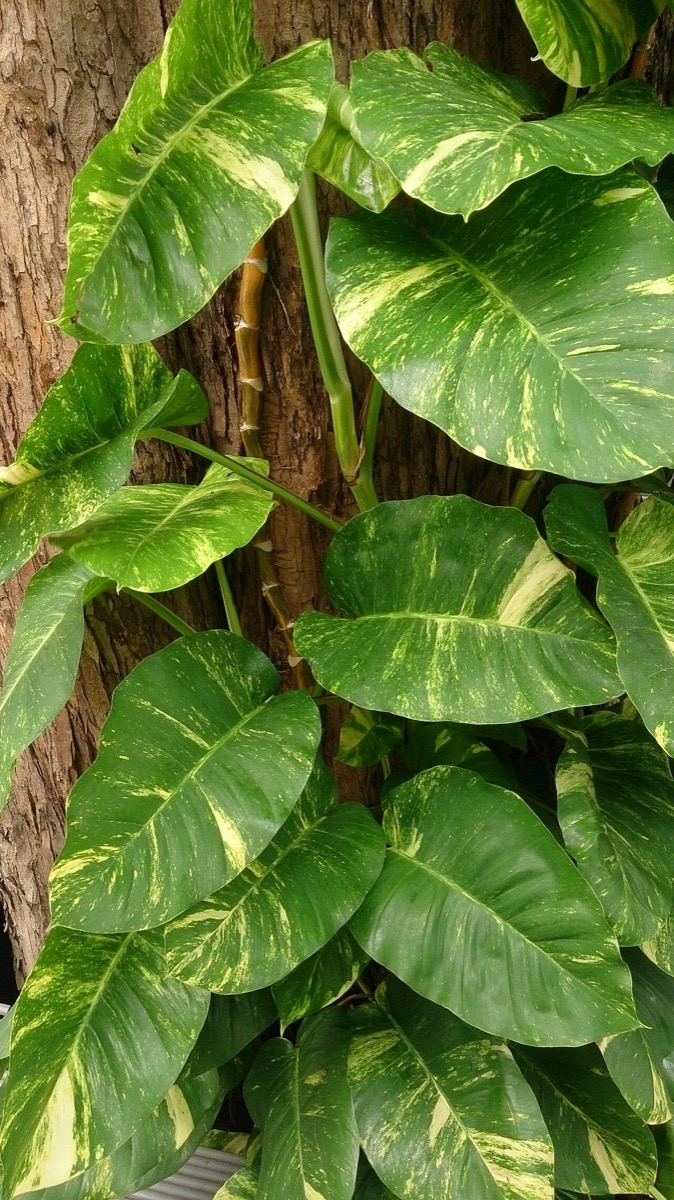
Also called Devil's Ivy, Money Plant, Ceylon Creeper, Hunter's Robe, Taro Vine.
Water every 7 to 10 days, allowing the top 3 to 5 cm (1 to 2 inches) of soil to dry out completely between waterings. Reduce watering to every 14 to 21 days during winter.
Prefers bright, indirect sunlight between 1,000 and 2,500 lux. Tolerates low-light levels down to 500 lux, though leaf variegation will revert to solid green; direct sunlight scorches the foliage.
A porous, well-draining potting mix consisting of 2 parts peat moss or coco coir, 1 part perlite, and 1 part orchid bark, with a target pH of 6.0 to 6.5.
Maintains healthiest growth between 18°C and 29°C (65°F to 85°F). Growth stalls below 15°C (59°F), and tissue damage occurs below 10°C (50°F).
Grows well at standard indoor humidity levels of 35% to 45%, but thrives and produces larger foliage at 50% to 70% relative humidity.
Apply a balanced, water-soluble fertilizer (such as 10-10-10 or 20-20-20) diluted to half-strength once every 4 weeks from March through September; withhold fertilizer during autumn and winter.
All parts of the plant contain insoluble calcium oxalate crystals and proteolytic enzymes. Chewing or ingesting the plant causes immediate oral pain, burning, swelling of the lips, tongue, and pharynx, excessive drooling, and vomiting.
How to tell them apart: Philodendron has rounded petioles, a distinct leaf sinus, and papery cataphylls (sheaths) that dry and shed at the nodes, whereas Epipremnum has grooved petioles and leaves with a thicker, waxier texture.
How to tell them apart: Scindapsus features matte, slightly velvety foliage with distinct reflective silver spots and an asymmetrical curved tip, whereas Epipremnum aureum leaves are glossy with irregular yellow, cream, or white streaks.
- Epipremnum aureum lacks a functional gibberellin-producing gene (EaGA3ox1), making it physiologically incapable of autonomous flowering; the species has not been observed flowering naturally in the wild or cultivation since 1962.
- The plant earns the name Devil's Ivy because it is nearly impossible to kill and stays green even when kept in dark, hostile conditions.
- The leaf shape completely transforms as the plant ascends tree trunks, developing large pinnatifid splits and perforations akin to a Monstera.
Not sure this is what you have?
Upload a photo and find out — with the lookalikes it could also be.
Identify my plant