Mexican Snowball
A stemless or short-stemmed succulent that forms tight rosettes of thick, spoon-shaped leaves reaching 8 to 10 cm in diameter. The foliage has a pale bluish-green to silvery-white hue protected by a distinct powdery coating. In late winter to spring, it produces arching pinkish-red inflorescences up to 25 cm tall with lantern-shaped pink flowers tipped in yellow.
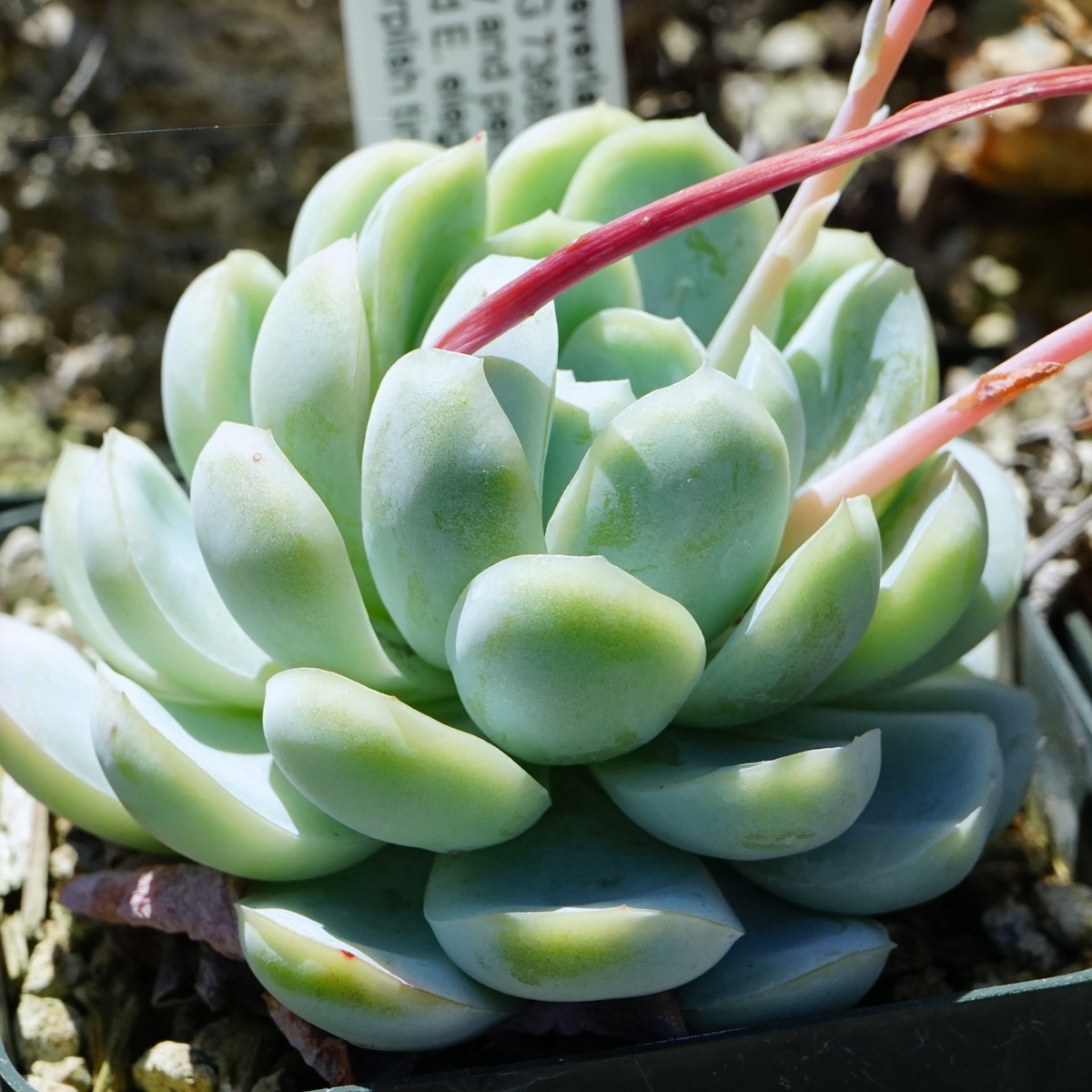
Also called Mexican Gem, White Mexican Rose.
Water thoroughly until water drains from the pot base, then allow the soil to dry out completely before watering again, approximately every 14 to 21 days in summer and every 30 to 45 days in winter. Never pour water directly into the central rosette, as trapped moisture causes rapid crown rot.
Requires at least 6 hours of direct sunlight daily; ideal on a south- or west-facing windowsill or under a 30W full-spectrum grow light placed 15 to 20 cm above the plant to prevent stretching (etiolation).
A gritty, low-organic mix consisting of 60% inorganic matter (pumice, perlite, or coarse grit) and 40% succulent potting compost with a pH of 6.0 to 7.0.
Maintains best growth between 18°C and 27°C (65°F to 80°F). Can tolerate brief drops to 4°C (40°F) if the potting substrate is completely dry, but sustains cell damage and necrosis at 0°C (32°F) or below.
Dry air between 30% and 50% relative humidity. Avoid humid rooms like enclosed bathrooms, as stagnant moisture promotes fungal leaf drop.
Feed once every 4 to 6 weeks from April to August using a low-nitrogen cactus and succulent fertilizer diluted to 1/4 strength (e.g., NPK 2-7-7). Do not fertilize in autumn or winter.
Echeveria elegans contains no known toxins harmful to domestic animals or humans.
How to tell them apart: Graptopetalum paraguayense quickly forms long, trailing woody stems and produces open, star-shaped white flowers with red spots, unlike the compact rosettes and bell-shaped pink-yellow blooms of Echeveria elegans.
How to tell them apart: Echeveria secunda features flatter, thinner blue-green leaves often marked with distinct reddish margins and tips, whereas Echeveria elegans has thicker, paler, alabaster-edged leaves.
- The powdery, chalky layer on its leaves is epicuticular wax called farina, which acts as a natural sunblock and water repellent; once rubbed off by touch, it does not regenerate on existing leaves.
- Like many desert succulents, it uses Crassulacean Acid Metabolism (CAM), keeping its stomata tightly closed during the day and capturing carbon dioxide only at night to reduce water loss.
- It rapidly produces lateral offsets on short stolons around the base of the mother plant, which can be sliced off and rooted once they reach one-third the size of the parent.
Not sure this is what you have?
Upload a photo and find out — with the lookalikes it could also be.
Identify my plant