Snake Plant
Dracaena trifasciata is an evergreen succulent perennial that grows upright, stiff, sword-shaped leaves directly from a thick underground rhizome. The foliage is dark green with light grey-green horizontal cross-banding and can reach heights between 60 cm and 120 cm indoors. It is exceptionally resilient to physical neglect, low humidity, and extended drought. While slow-growing, established plants occasionally produce terminal spikes of small, greenish-white fragrant flowers followed by orange berries.
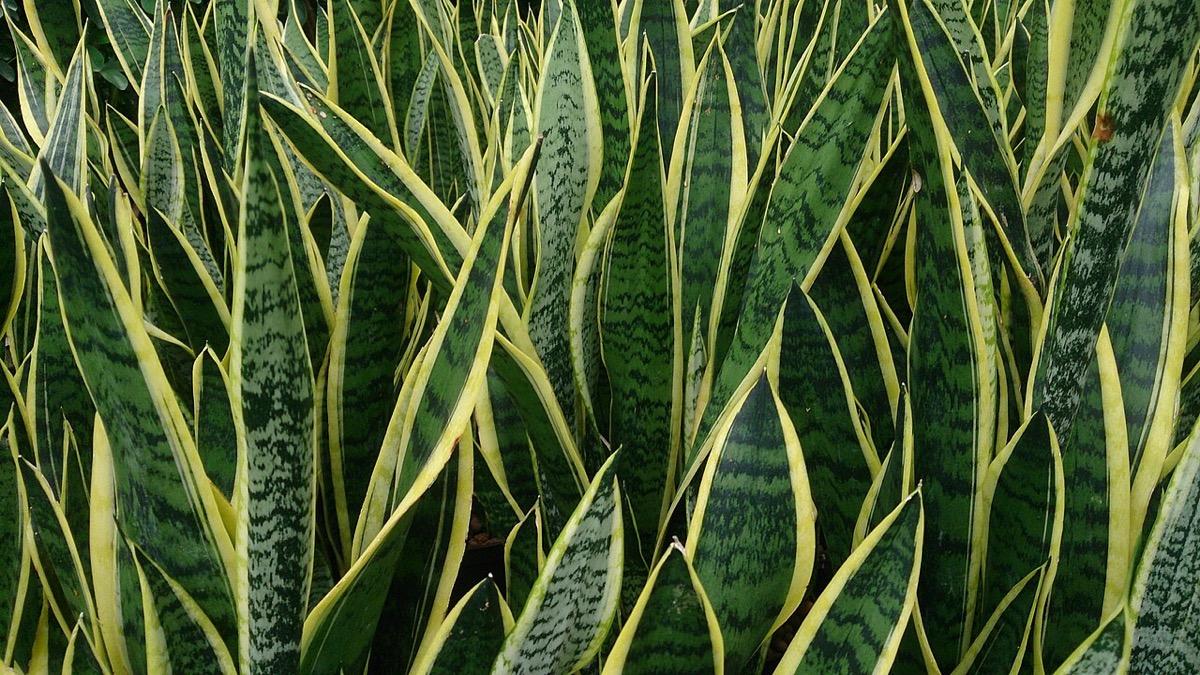
Also called Mother-in-law's Tongue, Saint George's Sword, Viper's Bowstring Hemp, Sansevieria trifasciata.
Water deeply with roughly 250 ml to 500 ml per standard pot only when the soil substrate has completely dried out to the bottom of the pot. In warm seasons, this is typically every 2 to 3 weeks; in winter, reduce watering to once every 6 to 8 weeks. Discard all runoff from the saucer immediately, as standing water will cause rhizome rot within days.
Tolerates deep shade to full sun. For optimal growth and defined leaf patterns, provide 4 to 6 hours of bright indirect light or filtered morning sunlight daily. Prolonged low light will slow growth to a near standstill and dull leaf variegation.
Requires a gritty, fast-draining potting mix. A commercial succulent or cactus mix combined with 30% perlite, coarse sand, or pumice with a pH of 5.5 to 7.0 prevents moisture retention around the rhizomes.
Maintains healthy growth between 18°C and 27°C (65°F to 80°F). Sustained exposure to temperatures below 10°C (50°F) causes leaf scarring, softening, and cellular collapse.
Thrives in average indoor relative humidity between 30% and 50%. High ambient humidity is tolerated provided soil remains dry, but misting the foliage should be avoided to prevent fungal leaf spot.
Apply a balanced liquid houseplant fertilizer diluted to half strength (NPK 10-10-10 or 20-20-20) once every 8 weeks from April through September. Do not fertilize during autumn and winter.
All parts of the plant contain saponins and insoluble calcium oxalate crystals. Ingestion by cats and dogs causes excessive salivation, vomiting, diarrhea, lethargy, and abdominal pain. In humans, ingestion causes localized mouth and throat irritation, mild nausea, and transient numbness of the tongue.
How to tell them apart: Dracaena cylindrica features fully rounded, cylindrical leaves without the flat, broad blade structure of Dracaena trifasciata.
How to tell them apart: Dracaena masoniana produces extremely wide, singular or paired, paddle-shaped leaves that can exceed 20 cm in width, unlike the clustered, narrower upright foliage of Dracaena trifasciata.
How to tell them apart: Aspidistra elatior has flexible, papery green leaves with prominent petiole stems, whereas Dracaena trifasciata has thick, rigid succulent leaves emerging directly from the basal soil level.
- It utilizes Crassulacean Acid Metabolism (CAM) photosynthesis, opening its stomata at night to absorb carbon dioxide and minimize water loss during the day.
- Propagating variegated cultivars (such as 'Laurentii') by leaf cuttings causes the yellow margin mutation to be lost; the resulting new offsets revert entirely to the non-variegated wild green form.
- The plant's tough, resilient leaf fibers were traditionally extracted and spun in West Africa to manufacture durable cords, fishing nets, and bowstrings.
Not sure this is what you have?
Upload a photo and find out — with the lookalikes it could also be.
Identify my plant