Dumb Cane
Dieffenbachia seguine is a broadleaf evergreen perennial grown for its patterned, variegated foliage. The thick, cane-like stems carry broad, ovate leaves that typically feature mottled white, cream, or pale green markings against deep green. In indoor cultivation, it routinely reaches between 1 and 2 metres (3.3 to 6.6 feet) in height. Lower leaves naturally yellow and drop over time as the central cane lignifies and extends.
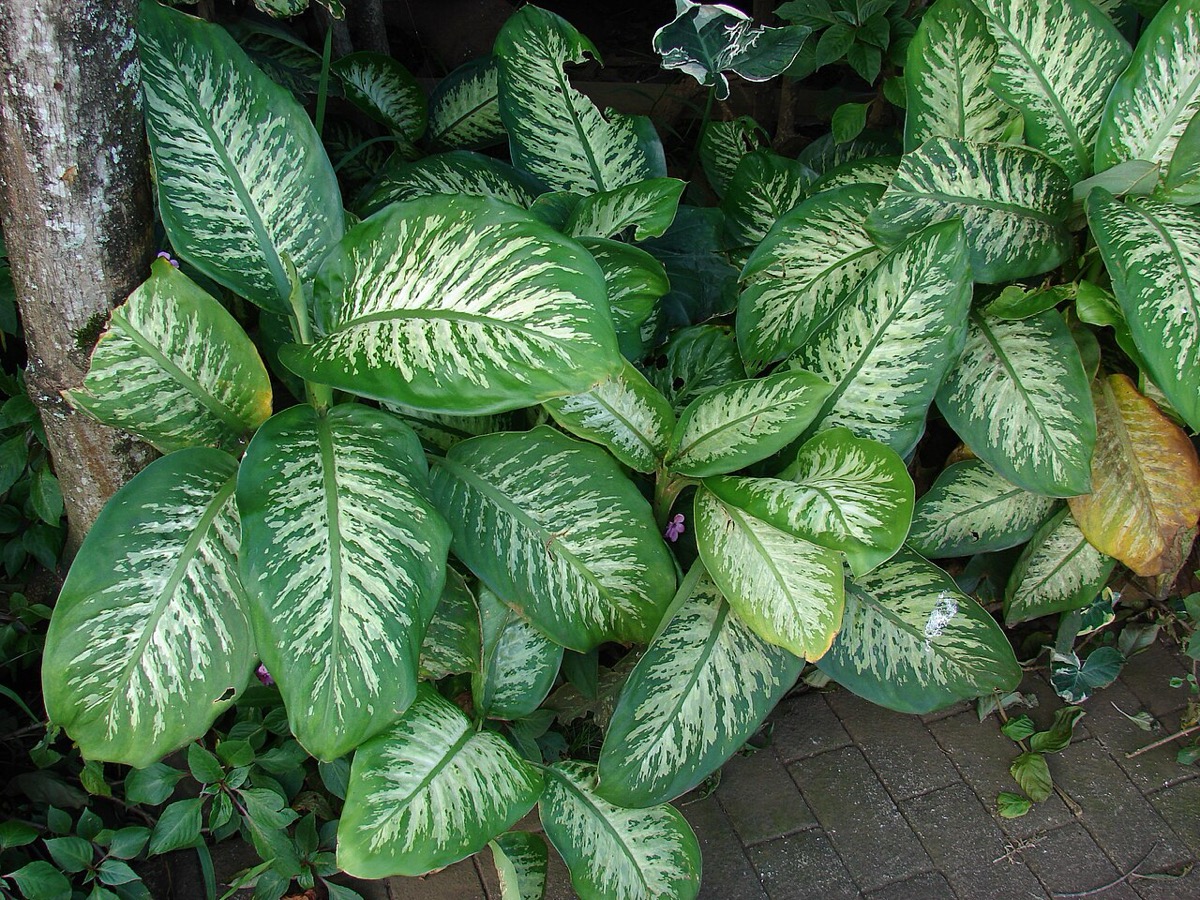
Also called Spotted Dumb Cane, Leopard Lily, Tuftroot.
How to care for it
Water thoroughly with approximately 500 to 750 ml of water whenever the top 3 to 5 cm (1 to 2 inches) of soil feels dry to the touch, which typically equates to once every 7 to 10 days in summer and once every 14 to 20 days in winter. Empty the drainage saucer immediately to prevent root rot.
Provide bright, indirect sunlight around 2,500 to 5,000 lux (such as 1 to 2 metres back from an east- or south-facing window). Avoid direct midday sun, which bleaches and scorches the variegated leaves within hours.
Use an aerated, well-draining potting mix consisting of two parts standard peat- or coco-based potting soil, one part perlite, and one part coarse orchid bark to retain moisture without waterlogging.
Maintain temperatures between 18°C and 27°C (65°F to 80°F). Sustained temperatures below 15°C (59°F) cause lower foliage to drop, while exposure below 10°C (50°F) causes irreversible chilling injury and stem collapse.
Requires ambient relative humidity above 50 percent. If room humidity drops below 40 percent during winter heating, run an ultrasonic humidifier nearby to prevent leaf edge browning and crisping.
Feed once every four weeks from March to September using a balanced 10-10-10 liquid houseplant fertiliser diluted to half the manufacturer's suggested dose (roughly 1.5 ml per litre of water). Cease feeding entirely during the low-light months between October and February.
Safety
All parts contain needle-shaped insoluble calcium oxalate crystals (raphides) stored inside specialized cells called idioblasts, combined with proteolytic enzymes. Chewing or crushing plant tissue mechanically ejects these needles into the mucous membranes of the mouth, causing immediate and intense burning, significant swelling of the tongue and throat that can temporarily impair speech, profuse salivation, vomiting, and potential airway obstruction. Sap contact with eyes causes severe corneal irritation and photophobia.
Often mistaken for
How to tell them apart: Aglaonema has narrower, more lanceolate leaves, grows on much thinner clustering stems rather than a distinct thick woody cane, and lacks the aggressive stinging sap of Dieffenbachia.
How to tell them apart: Variegated cultivars of Spathiphyllum produce leaves directly from a subterranean rhizome on slender, individual petioles without forming a true upright vertical cane, and their veins run parallel from the midrib to the edge rather than arching.
Worth knowing
- The common name 'dumb cane' stems from the temporary loss of speech caused by the swelling of vocal cords and tongue after ingesting its sap.
- The calcium oxalate needles are held under hydraulic pressure inside barrel-shaped cells and actively shoot out like microscopic darts into oral tissues when the cell wall ruptures during biting.
- It was historically used by indigenous tribes in South America to coat the tips of blowgun poison darts due to the irritant and inflammatory properties of its sap.
Not sure this is what you have?
Upload a photo to find out, along with the lookalikes it could also be.
Identify my plant