Flamingo flower
Anthurium andraeanum is an evergreen epiphyte known for its glossy, dark green heart-shaped foliage. It produces a brightly coloured, waxy modified leaf called a spathe surrounding a narrow central spike called a spadix. Individual blooms persist on the plant for several months under stable conditions. In the wild, it grows anchored to tree bark rather than deep in ground soil.
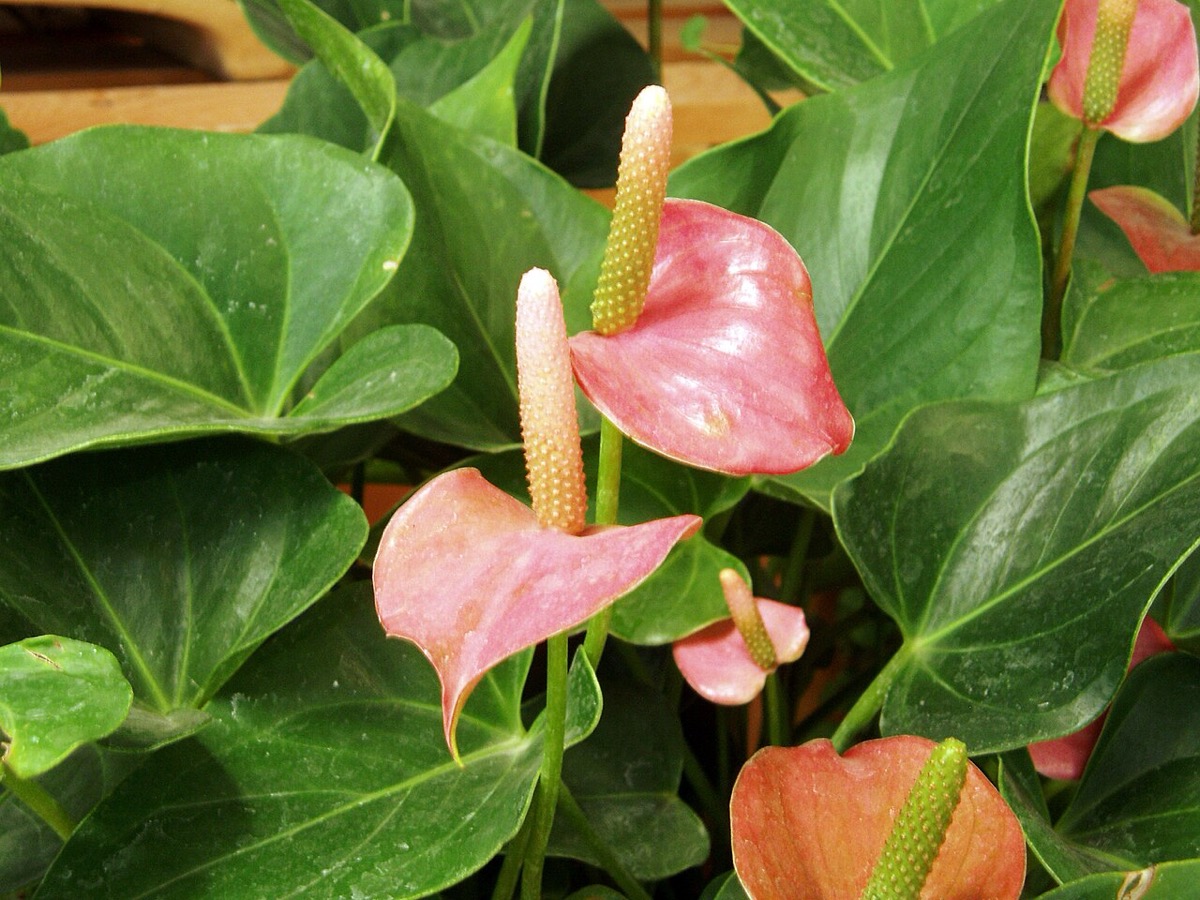
Also called Painter's palette, Oilcloth flower, Tailflower.
How to care for it
Soak thoroughly once the top 3 cm of substrate feels dry to the touch, roughly every 7 to 10 days in warm months and every 12 to 14 days in winter. Never leave the pot standing in runoff water, as the epiphytic roots rot quickly.
Position in bright, indirect light, roughly 1 to 2 metres from an east- or south-facing window with sheer filtering. Direct sun scorches the foliage and discolours the spathes, while prolonged deep shade prevents flowering.
An open, coarse, well-draining epiphytic mix comprising equal parts orchid bark, perlite or pumice, and peat moss or coco coir, with a pH of 5.5 to 6.5.
Maintain between 18°C and 27°C (65°F to 80°F). Sustained temperatures below 15°C (59°F) cause cold damage, stunted growth, and yellowing leaves.
Requires 60% to 80% relative humidity. Levels consistently below 50% cause dry leaf tips and failure of new spathes to unfurl properly.
Feed every 6 to 8 weeks from spring to early autumn using a balanced or high-phosphorus liquid houseplant fertilizer diluted to quarter strength. Do not fertilize in winter.
Safety
All plant parts contain needle-sharp insoluble calcium oxalate crystals. Chewing or ingesting releases these crystals, causing immediate intense burning of the lips, tongue, and throat, severe oral swelling, drooling, and difficulty swallowing. Direct contact with sap can trigger contact dermatitis.
Often mistaken for
How to tell them apart: Anthurium scherzerianum features a spiraled or curly spadix and lanceolate leaves, whereas Anthurium andraeanum has a straight, cylindrical spadix and distinctly heart-shaped leaves.
How to tell them apart: Spathiphyllum wallisii has papery, non-waxy white spathes and thin lanceolate leaves, lacking the glossy, plastic-like texture and cordate foliage of Anthurium andraeanum.
Worth knowing
- The colourful heart-shaped 'petal' is not a flower, but a modified leaf called a spathe designed to attract pollinators to the microscopic true flowers densely packed along the central spadix.
- Because it is naturally an epiphyte, its thick, fleshy roots can emerge into open air along the stem to absorb ambient moisture and anchor against surfaces.
- A single spathe can remain vibrant and intact on the plant for eight to twelve weeks, making it one of the longest-lasting indoor floral displays.
Not sure this is what you have?
Upload a photo to find out, along with the lookalikes it could also be.
Identify my plant