Aloe vera
Aloe vera is a stemless or short-stemmed succulent with thick, fleshy, grey-green leaves arranged in a dense rosette. The leaf margins are lined with small, soft white serrations. Inside the tough rind is a clear mucilaginous gel alongside a layer of bitter yellow latex. Mature plants grown outdoors produce tubular yellow flowers on an upright central spike up to 90 cm (35 in) tall.
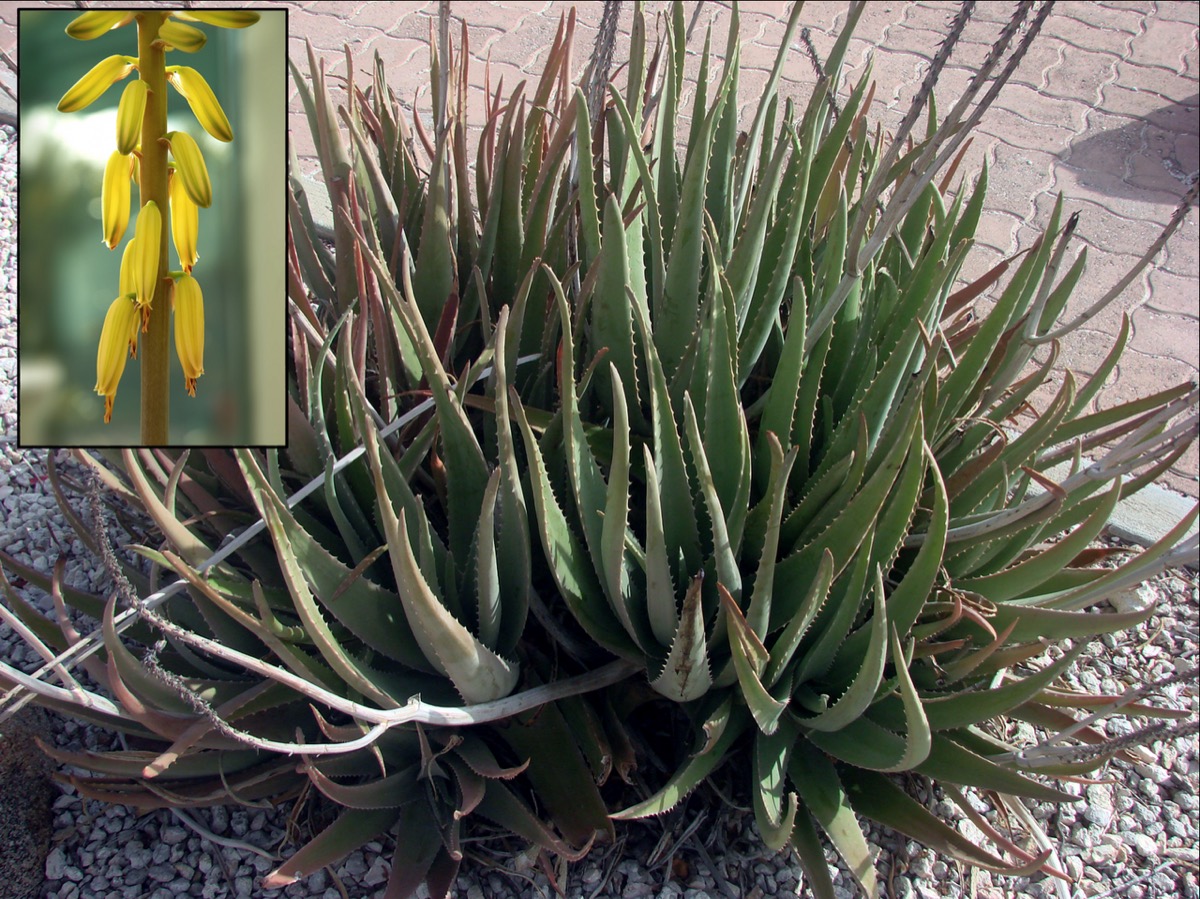
Also called True Aloe, Burn Plant, First Aid Plant, Barbados Aloe.
Drench thoroughly every 2 to 3 weeks in spring and summer, ensuring the potting medium dries out completely between waterings. Reduce to once every 4 to 6 weeks in winter.
Requires at least 6 hours of bright light daily, including 3 to 4 hours of direct sunlight. Insufficient light causes leaves to stretch, narrow, and bend under their own weight.
Gritty, fast-draining cactus and succulent mix composed of roughly 50% inorganic matter such as perlite, pumice, or coarse sand.
Optimal growth occurs between 13°C and 27°C (55°F to 80°F). Leaf tissue undergoes cellular collapse and rotting when exposed to temperatures below 4°C (40°F).
Thrives in dry air with 30% to 40% relative humidity. High ambient humidity combined with damp soil accelerates fungal root and leaf base rot.
Feed once in early spring and once in mid-summer with a balanced, water-soluble succulent fertilizer diluted to half strength. Do not fertilize during autumn or winter.
The yellow sap (aloin latex) directly beneath the leaf epidermis contains anthraquinones and saponins, which cause abdominal cramps, vomiting, and diarrhea in humans and pets.
How to tell them apart: Aloe arborescens develops an upright, branching woody trunk up to 2 to 3 metres tall, whereas Aloe vera stays low and virtually stemless.
How to tell them apart: Agave leaves end in a single rigid, needle-sharp terminal spine and have fibrous, non-gelatinous pulp.
How to tell them apart: Soap aloe retains distinct H-shaped pale blotches into adulthood and bears flat-topped coral-red flower clusters, unlike the unspotted mature leaves and yellow flower racemes of Aloe vera.
- Aloe vera utilizes Crassulacean Acid Metabolism (CAM), keeping stomata closed during the heat of the day and opening them at night to capture carbon dioxide.
- Juvenile specimens naturally display pale white spots along the foliage, but these markings vanish as the leaves mature.
- The bitter yellow aloin latex beneath the outer rind serves primarily as a chemical defense mechanism to deter browsing herbivores in the wild.
Not sure this is what you have?
Upload a photo and find out — with the lookalikes it could also be.
Identify my plant