Chinese Evergreen
An herbaceous evergreen perennial with upright stems bearing lance-shaped, leathery leaves marbled in shades of silver, gray, and green. It naturally grows on shaded forest floors, adapted to low light levels and warm, sheltered conditions. Mature plants occasionally produce small greenish-white spathe-and-spadix inflorescences followed by bright red berries. In indoor cultivation, it forms a dense clump typically reaching 30 to 60 cm (12 to 24 in) in height.
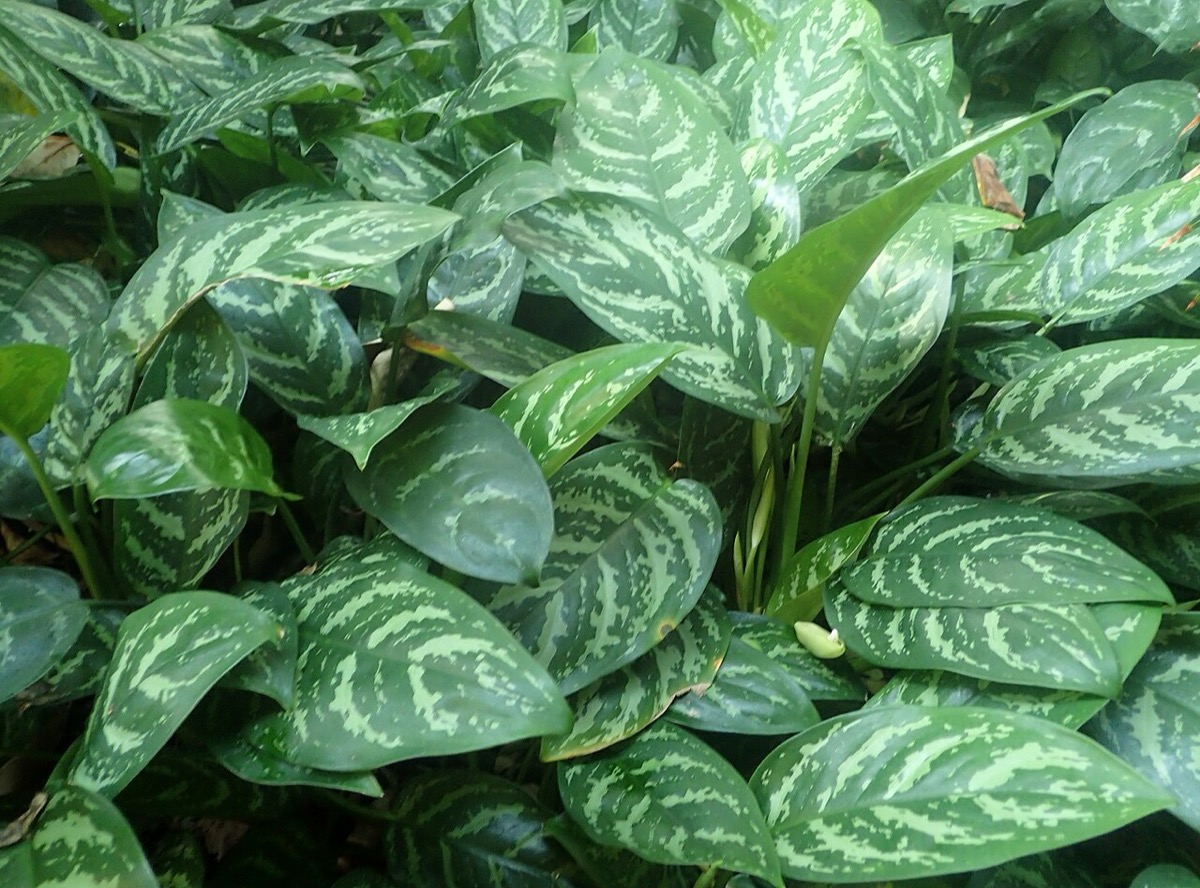
Also called Philippine Evergreen, Poison Dart Plant.
How to care for it
Allow the top 3 to 5 cm (1 to 2 in) of soil to dry out between waterings. Drench the pot with roughly 300 to 500 ml of water until it drains freely from the base, watering roughly every 7 to 10 days in summer and extending to every 14 to 21 days in winter.
Thrives in medium to low indirect light between 500 and 1,500 lux. Keep completely shielded from direct midday sun, which will bleach and scorch the patterned foliage.
A loose, airy potting mix composed of two parts peat moss or coco coir, one part perlite, and one part orchid bark to ensure rapid drainage and prevent rhizome rot.
Maintain between 18°C and 27°C (65°F to 80°F). Sustained temperatures below 15°C (60°F) cause chilling injury, leading to dark, water-soaked foliage and systemic collapse.
Optimal relative humidity is 50% to 70%, though it tolerates typical home levels down to 40% without developing crisp margins if moisture at the roots is steady.
Apply a balanced liquid houseplant fertilizer (such as 10-10-10) diluted to half strength (1 ml per litre of water) once every 6 to 8 weeks during spring and summer only.
Safety
All plant tissues contain insoluble calcium oxalate raphide crystals. Chewing foliage releases micro-needles that embed in mucosal membranes, causing acute oral pain, salivation, swelling of the lips and tongue, and vomiting.
Often mistaken for
How to tell them apart: Dieffenbachia features noticeably thicker, cane-like stems and broader, thinner leaves with irregular mottled blotches rather than the symmetrical lateral silver striping of Aglaonema commutatum.
How to tell them apart: Peace Lily has solid dark green, non-variegated leaves with pronounced, grooved parallel veins, and produces showy, pure white petal-like spathes on long stalks.
Worth knowing
- Exposure to temperatures under 10°C triggers immediate cell lysis in this species, turning leaves black within 24 to 48 hours.
- Fertilized spadices mature into clusters of fleshy, bright red berries that remain ornamental on the plant for months.
- Cultivars of Aglaonema commutatum with predominantly dark green foliage tolerate lower light thresholds than highly variegated or silver-washed cultivars.
Not sure this is what you have?
Upload a photo to find out, along with the lookalikes it could also be.
Identify my plant